
News
20 June: what is celebrated today
20 June seems like a day written in two inks. One, yellow and bright, speaks of summer, the desire to go out, and the feeling that the world opens a little wider. The other is more serious: it reminds us that people are forced to flee, communities seek refuge, identities are sustained by symbols, and bodies fight invisible battles. Between celebration and awareness, today’s calendar offers something like a compass: joy, yes, but with memory; lightness, yes, but without indifference.
Yellow Day, the happiest day of the year
In contrast to the famous ‘Blue Monday’, 20 June became popular as Yellow Day: a viral observance coloured yellow, the colour associated in psychology with optimism, creativity and energy. The idea rests on a statistical intuition: close to the summer solstice, with more daylight hours, pleasant temperatures and the promise of holidays, spirits tend to rise. It is not a magic formula, but it is a recognisable emotional climate: the body wakes earlier, the street beckons, and the mind thinks with less weight.
Celebrating it does not require grand gestures: it is enough to identify what truly brightens things. Sometimes it is a song, an overdue conversation that finally takes place, a walk with no destination, a childhood memory that returns intact. Yellow Day works as a simple reminder: happiness is often concrete and everyday, and it is worth looking it in the face before it passes by.
World Refugee Day
On the same day we celebrate light, the calendar compels us to think of those who have suddenly lost it. World Refugee Day, commemorated every 20 June since 2001, makes visible the millions of refugees, displaced people and asylum seekers who have had to leave their homes because of wars, violence or persecution. The date is associated with the anniversary of the 1951 Convention relating to the Status of Refugees, which established an international framework for protection.
In 2024, the focus was on solidarity and welcome: keeping doors open is not only a humanitarian gesture, it is also a political and moral decision. Being a refugee means starting again in an unfamiliar place, with accumulated grief and practical challenges —health, work, education— often aggravated by xenophobia or precarity. Remembering this day means remembering something elementary: no one chooses to flee for pleasure, and dignity should not depend on a passport.
International Surfing Day
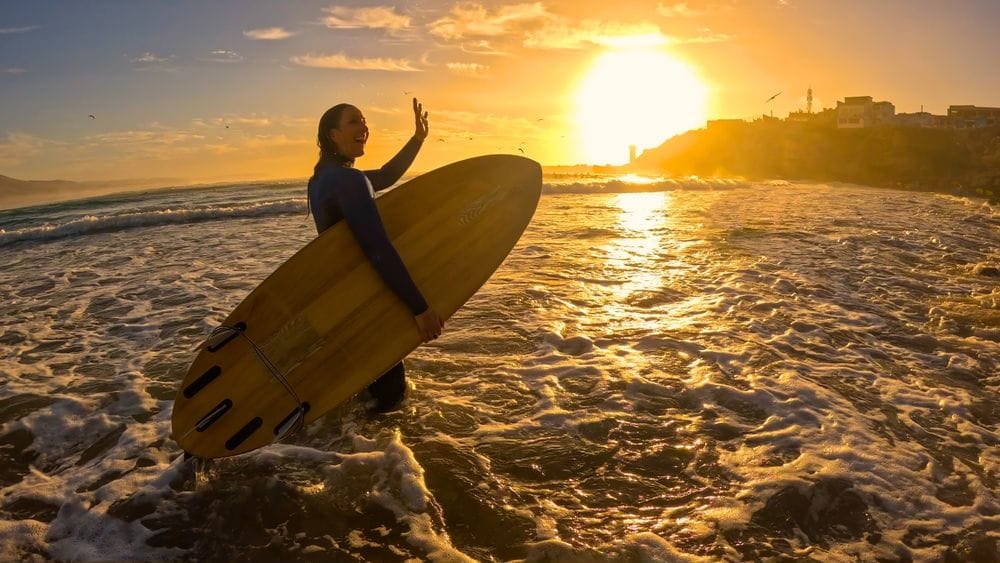
The third Saturday in June —which falls on 20 June in 2026— marks International Surfing Day, promoted since 2004 by Surfing Magazine and the Surfrider Foundation. It is not only about paying tribute to a sport: the focus is on the ocean as home and responsibility. Riding a wave is, in a way, reading the sea; and those who learn to read it often end up wanting to protect it.
Surfing has ancient roots in Polynesia and a culture that has influenced music, film and fashion, but perhaps its best legacy is another one: the awareness that the sea is not a backdrop, but a living system. Celebrating it can mean practising it, looking at it, or joining coastal conservation actions. Joy can be ecological too.
World Wi-Fi Day
There is a modern happiness that makes no noise: that of being connected when we need to be. 20 June is dedicated to Wi-Fi, at the initiative of sector organisations seeking to underline its role in connecting communities and cities. Since the technology became popular in the late 1990s, wireless networking has become everyday infrastructure: it supports work, study, information, care and human connections.
But this observance also points to the divide: for millions of people, basic connectivity still does not exist or is too expensive. Celebrating Wi-Fi, then, is not only applauding convenience; it is imagining fairer access, where connection is a tool for opportunity and not an invisible border.
World Facioscapulohumeral Muscular Dystrophy Day
This 20 June also recalls a rare disease: facioscapulohumeral muscular dystrophy (FSHD), a genetic and inherited disorder that causes progressive muscle weakness —especially in the face, shoulders and arms— and can affect each person very differently. It was described in 1885 by Landouzy and Dejerine, and is commemorated today to promote research, visibility and better support.
Behind the long name are real lives with daily adaptations: physiotherapy, pain management, periods of stability and others of progression, constant learning about autonomy. These dates matter because rare should not be synonymous with invisible: when a condition is known, it is better understood; and when it is understood, it is accompanied with more humanity.
World Juggling Day
The third Saturday in June also marks World Juggling Day, linked to the history of the International Jugglers Association (founded in 1947). Juggling is one of those ancient crafts that seem like pure play, but conceal discipline: coordination, patience, attention, repetition until the air obeys.
There is something symbolic about juggling: the art of holding several things up without everything falling. In the age of screens, learning a physical and slow skill —one ball, two, three— can be a form of mental rest. It is also a shared joy: in squares, fairs and festivals, wonder remains a universal language.
Flag Day
In Argentina, 20 June is a public holiday and Flag Day is celebrated in honour of Manuel Belgrano, creator of the national symbol, who died on that same day in 1820. The commemoration was established by law in 1938 and is experienced as a day of identity: a country seeing itself in its colours, remembering a history of independence and a shared project.
The flag is not only cloth: it is narrative, memory, belonging. That is why the celebration often has an emotional centre in Rosario, beside the Flag Monument, where a simple pact is renewed: the idea of a community that, despite its tensions, still seeks to recognise itself in something shared.