
News
Advanced Factories 2026 will bring Barcelona the major debate on how to automate the food industry
Advanced Factories 2026 will bring together more than 680 firms and more than 33,000 professionals at Fira Barcelona Gran Via from 5 to 7 May, with food-industry automation as one of the congress’s key focuses.
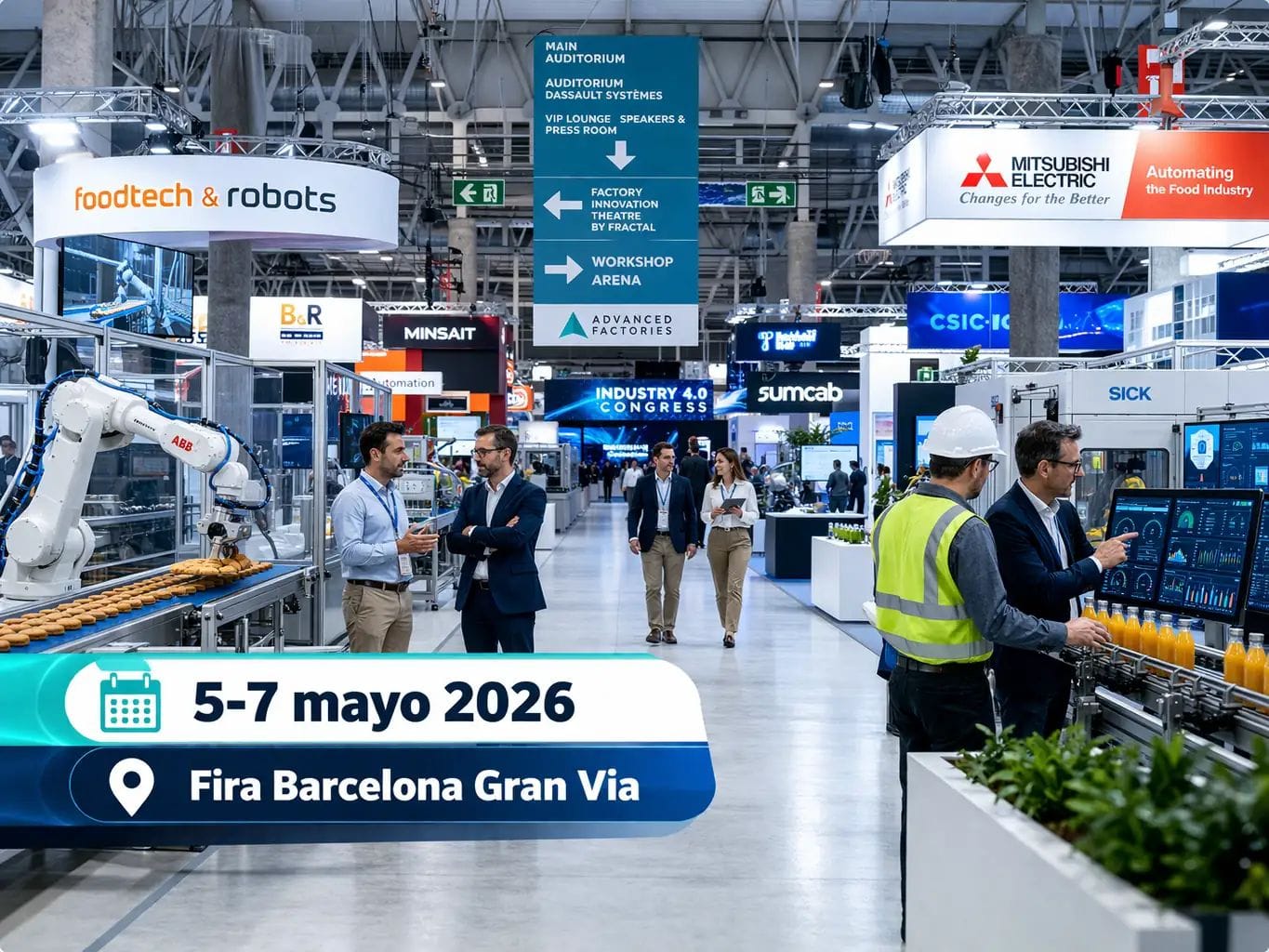
The food industry will turn its attention to Barcelona again from 5 to 7 May, when Advanced Factories 2026 brings together at Fira Barcelona Gran Via some of the major companies redefining how food is produced, controlled and distributed in an increasingly automated environment. This year’s edition will focus on a very specific question: how to build more efficient and sustainable factories without losing control over quality, costs and traceability.
The real draw is not the event itself, but the moment the sector is going through. Food remains the main manufacturing branch of Spanish industry, with turnover of close to 179 billion euros, according to the data cited in the congress announcement. In that context, pressure to produce more, reduce waste and respond to ever greater demands for safety and transparency is pushing companies to accelerate plant automation.
That is why the food block of the Industry 4.0 Congress promises to be one of the best attended parts of the event. Executives from companies such as Coca-Cola Europacific Partners, GB Foods, Damm, PepsiCo, Unilever, Mars and Prolongo will share cases related to automation, line control, energy optimisation, process digitalisation and end-to-end traceability. More than a theoretical conversation about innovation, what is being considered here is how to make a food factory make better decisions, waste less and respond faster.
One of the keys to the debate will be the shift from reactive processes to predictive environments. The congress agenda includes technologies such as AI, digital twins, the IIoT, advanced vision, industrial analytics and MES systems, tools that make it possible to connect production, logistics and distribution in a single flow of information. In other words, the food factory of the future does not just automate tasks; it anticipates failures, adjusts consumption and tracks each batch with far greater precision.
Traceability will be another major focus. And that makes sense: in food, knowing what has happened to each batch, where an incident occurred or which part of the process failed is no longer a technological extra, but a competitive requirement. The congress aims to show precisely how sensors, industrial platforms and record-keeping systems make it possible to strengthen control, safety and trust throughout the chain.
There will also be a clear message about sustainability, but it is worth grounding it here. In practice, the sector’s new competitiveness involves producing more with fewer resources, cutting waste, making better use of energy and designing more circular processes. This is the less eye-catching part of the technology discourse, but probably the most decisive for companies operating with tight margins and rising industrial costs.
Advanced Factories will hold its tenth edition in 2026, and the organisation expects to bring together more than 680 firms and more than 33,000 professionals. That scale helps explain why the congress wants to present itself not only as a showcase for robots and software, but as a barometer of where industry in Europe is heading. And this year one of the clearest answers appears to lie in food.
Mentioned in this story
- Advanced Factories 2026
- Coca-Cola Europacific Partners
Names as the source story gives them, not translated.