
News
At least 46 dead in a collision between two high-speed trains in Toledo: high-speed rail traffic between Madrid and Andalusia suspended
A serious rail accident recorded this Wednesday, 28 October, in the province of Toledo has left at least 46 dead, according to sources from the Gobierno de Castilla-La Mancha. An AVE de Renfe train rear-ended an Iryo train that was stopped on the track near Urda. More than 540 people were travelling on both trains. High-speed rail traffic between Madrid and Andalusia is suspended until further notice.
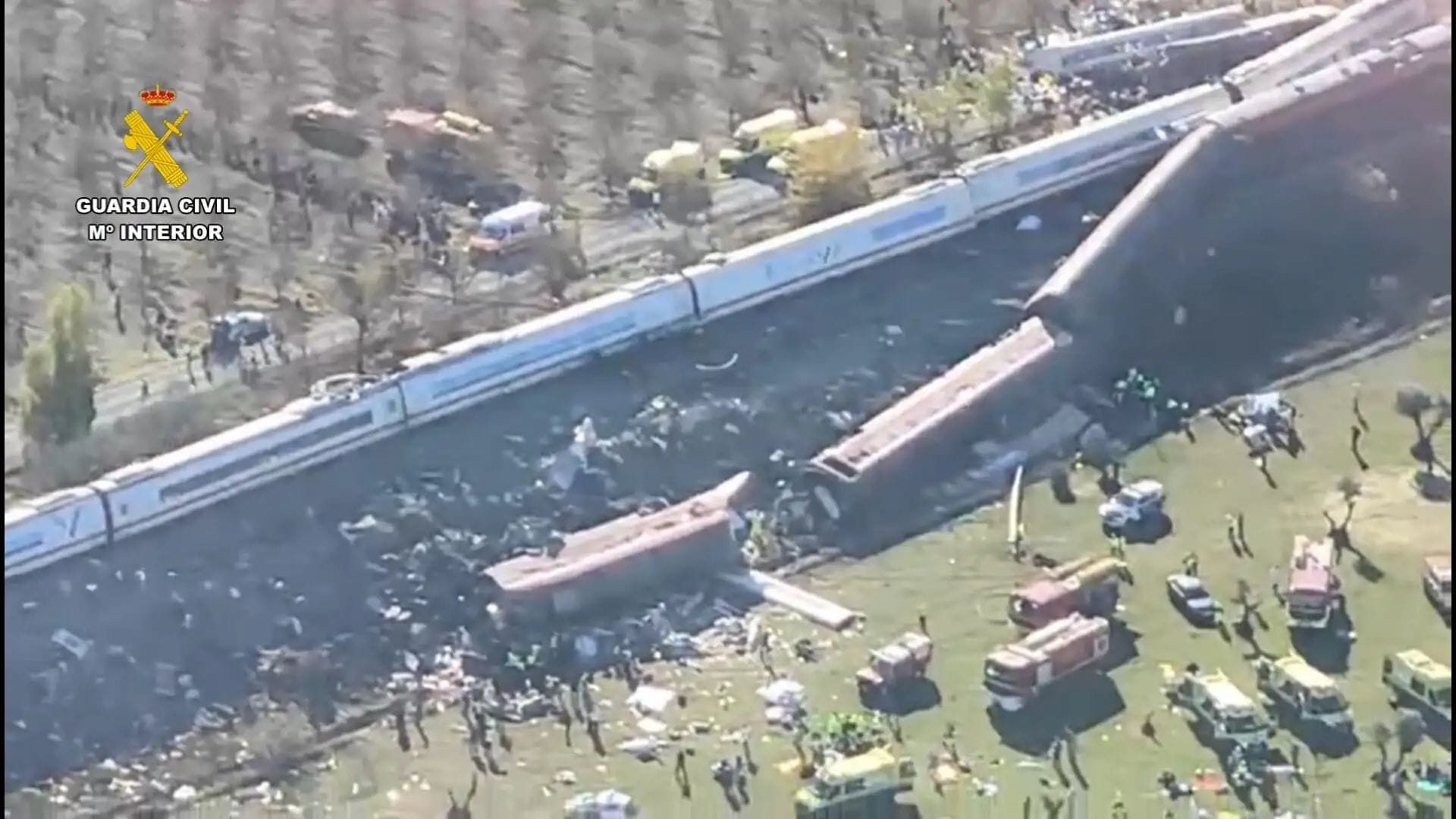
Spain once again faces a railway tragedy just nine months after the Adamuz accident in Córdoba. This time, the incident has occurred on the Madrid-Sevilla high-speed line, between the Toledo towns of Mora, Orgaz and Urda.
The collision took place at around 8:54 am, at kilometre point 118. Initial reports indicate that an AVE train rear-ended an Iryo train that was stationary.
The crash caused at least two carriages to fall down an embankment, making rescue operations more difficult.
The provisional toll is 46 fatalities, although authorities warn that the number could rise as emergency work continues.
More than 540 passengers were travelling on the two trains
According to data provided by the Gobierno de Castilla-La Mancha, there were 397 passengers on Renfe’s AVE 2080, while the Iryo train was carrying another 147 passengers and a baby.
In total, around 545 people were on board the two trains.
Rescue teams are working at the scene to assist the injured and locate those affected.
Some survivors have described moments of great confusion after the impact. Miguel Ángel Pérez, who was travelling in the last carriage of the AVE, told TVE that passengers had to hold on to their seats during the jolt and that some managed to leave the train by breaking the windows.
Medical services have deployed medical helicopters and have alerted hospitals in Castilla-La Mancha y Madrid to prepare for the arrival of casualties.
Possible human error at the Atocha control centre under investigation
The causes of the accident have not yet been officially determined, although initial investigations are considering a possible human error related to railway traffic management.
According to government sources cited by El País, a fault in the automatic signalling system had forced several trains in the area to stop.
Traffic was later resumed under manual control. In this context, an operator at the Atocha control centre may have mistakenly authorised the AVE to proceed while the Iryo train was still on the track.
This hypothesis will need to be verified during the investigation. For now, no definitive cause has been established and no responsibilities have been determined.
Trains between Madrid and Andalucía suspended
The accident has forced the suspension of high-speed rail traffic on the southern corridor.
Adif has suspended services between Madrid, Ciudad Real y Andalucía until further notice and has asked passengers with tickets for affected journeys not to go to the stations.
Trains already running on the line have been stopped at various stations along the route.
Iryo has cancelled services from Atocha to the southern corridor.
Renfe has enabled ticket changes and cancellations for affected passengers. According to information provided at Atocha station, passengers can request a full refund of their tickets.
At present, no date has been given for the resumption of normal services.
Helplines for families and those affected
Rail companies and emergency services have set up dedicated phone lines for those affected by the accident and their families.
Renfe: 900 10 10 20.
Iryo: 900 001 403.
Emergencias 112 de Castilla-La Mancha: 900 122 112.
Renfe has specifically requested that its helpline be used only for enquiries related to victims and those affected by the incident.
Support services for families have also been set up at Madrid-Atocha y Sevilla stations.
Unidad Militar de Emergencias involved in rescue
The Gobierno de Castilla-La Mancha has requested the involvement of the UME due to the seriousness of the situation.
The Ministerio del Interior has activated its deployment to assist teams already working on the ground.
Personnel from the Guardia Civil, firefighters from Toledo y Ciudad Real, Protección Civil and medical services are all involved in the operations.
The autonomous community has also raised its Plan Territorial de Emergencia (Platecam) to level 2.
Madrid has mobilised additional resources, including fire engines, ambulances and specialists in mass casualty emergencies.
In addition, the Centro de Transfusión de la Comunidad de Madrid has issued an urgent appeal for blood donations in anticipation of possible hospital needs.
Spain suffers another serious rail accident after Adamuz
The Toledo crash comes less than a year after the Adamuz railway tragedy in Córdoba, which occurred on 18 January 2026.
In that accident, involving Iryo y Renfe trains, 46 people died and another 292 were injured.
The new incident has led the central government and various regional administrations to suspend some of their official events.
The president of the Government, Pedro Sánchez, has expressed his shock and offered his support to the victims and their families.
Institutional and political activities scheduled for Wednesday have also been cancelled.
The investigation remains open and the casualty figures are provisional. Emergency services continue to work at the scene while rail services between Madrid and Andalucía remain suspended.
Information updated on 28 October 2026, with provisional data available during the morning.