
News
Barcelona hosts the first Spain-Brazil Summit with Sánchez and Lula and a dozen strategic agreements
Pedro Sánchez and Luiz Inácio Lula da Silva have chaired the 1st Spain-Brazil Summit at Pedralbes Palace, the first bilateral meeting of this level between Spain and a Latin American country, concluded with a joint political declaration and several agreements on the economy, technology, culture, social rights and consular cooperation.
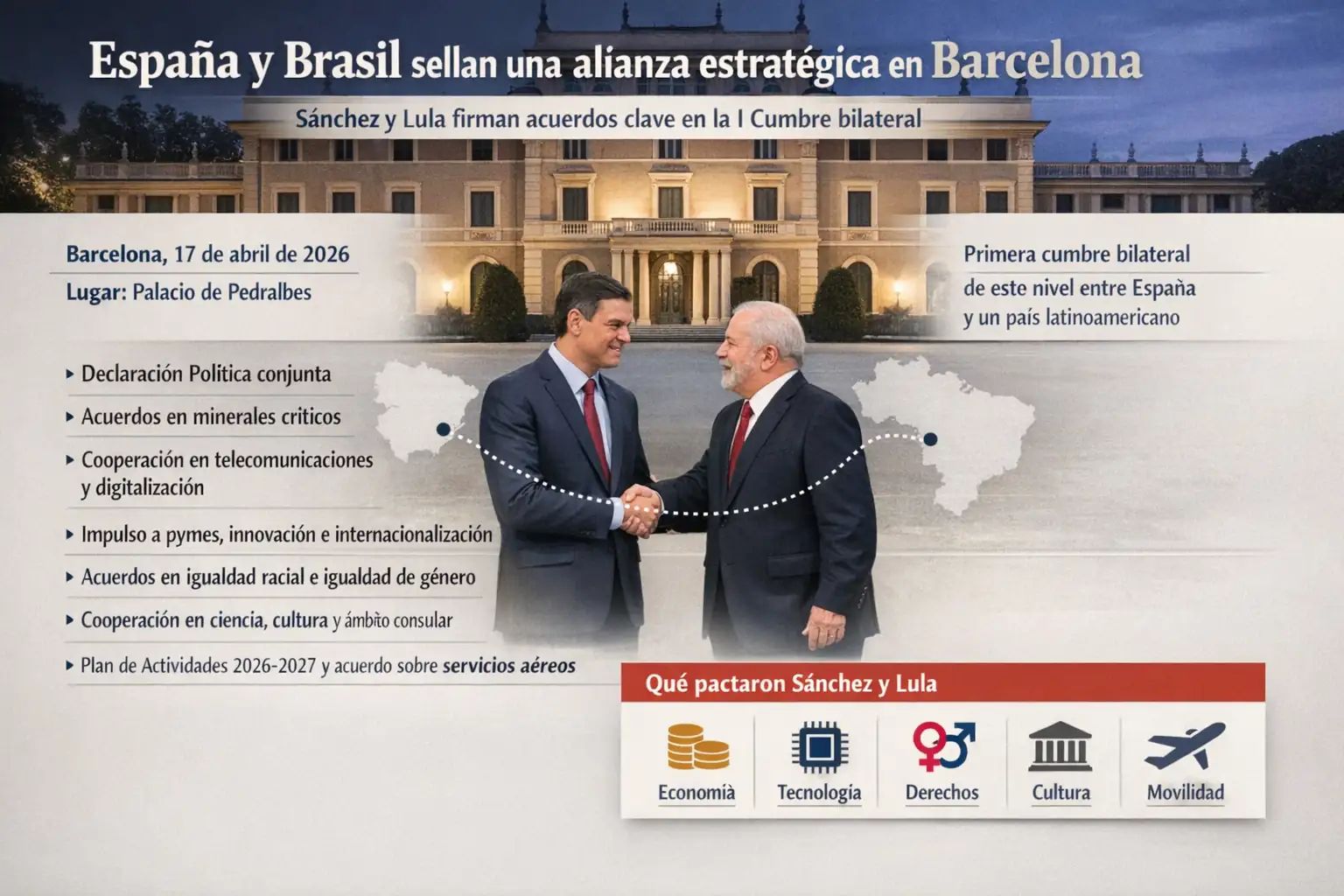
Barcelona hosted the 1st Spain-Brazil Summit this Friday, 17 April, the first bilateral summit at this level between Spain and a Latin American country. The meeting was held at the Palacio de Pedralbes and was chaired by Pedro Sánchez and Luiz Inácio Lula da Silva, with the participation of large ministerial delegations from both governments. The day ended with a joint Political Declaration and the signing of several agreements on the economy, technology, culture, social rights and consular cooperation.
The summit’s central message was political, but also economic. Sánchez and Lula defended a strategic relationship based on democracy, human rights, the rule of law and stronger multilateralism. Both leaders presented their alliance as a shared response to extremism and international instability, at a gathering which also coincides in Barcelona with other meetings of progressive leaders.
One of the agreements with the greatest economic weight was the memorandum on critical minerals, intended to strengthen cooperation on strategic raw materials for the energy transition and the technology industry. That pact is joined by another agreement to promote the competitiveness of SMEs, sustainability, innovation and internationalisation, supporting bilateral investment opportunities and financial instruments for Spanish and Brazilian companies.
The digital agenda also featured prominently. Spain and Brazil have signed a memorandum to strengthen collaboration in telecommunications and information and communication technologies, with a work plan that opens the door to cooperation on connectivity, infrastructure and administrative modernisation.
On the social front, the summit produced agreements on racial equality, gender equality and combating violence against women, as well as a memorandum on the social and solidarity economy. Agreements were also signed on science, technology and innovation, cultural cooperation, and a work plan on consular matters to improve services for citizens of both countries.
Another important area was mobility and social protection. The summit served to expand cooperation in social welfare and social security, with an Activities Plan for 2026-2027 to facilitate coordination between the two systems. Alongside this, the signed package includes an agreement on air services, which broadens the practical scope of the bilateral relationship.
The meeting also leaves a relevant political fact: the Spanish Government presents this gathering as a historic step in institutionalising its relationship with Brazil. Not only because of the volume of agreements, but because it makes Brazil the first Latin American partner to hold a bilateral summit of this rank with Spain.
Beyond the diplomatic photo opportunity, the Barcelona summit seeks to project a broader idea: that Spain and Brazil want to act as two poles of democratic stability and economic cooperation in an international context marked by polarisation, war and the rise of the far right. That framework explains both the Political Declaration and the tone of the meeting between Sánchez and Lula.