
News
Barcelona doubles its tourist tax and ranks among European cities with the most expensive nights for visitors
Since 1 April, Barcelona charges 8.40 euros per person per night in four-star hotels, a rise that places it among the European cities with the highest tourist tax and reopens the debate on tourism, prices and competitiveness.
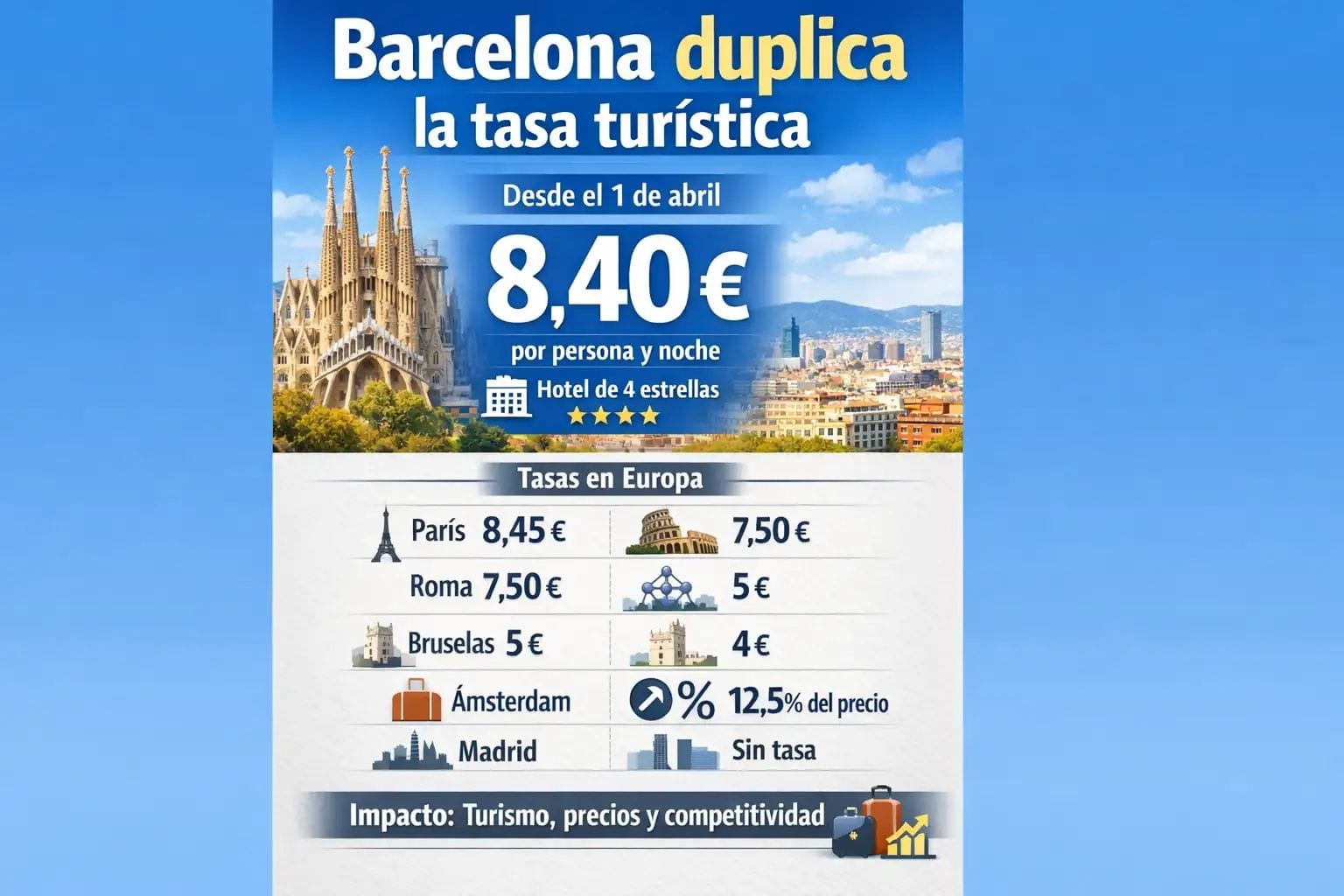
Barcelona has doubled its tourist tax since April. It now ranks among the European capitals with the highest tax per night. The increase affects those planning to stay in the city. Other cities apply different formulas. Find out how Barcelona compares.
Those visiting Barcelona have noticed an important change since 1 April: the tourist tax they must pay per night has doubled, placing the city among the European capitals with the highest overnight tax. This rise directly affects tourists' pockets and the perception of the city as a destination.
The tax system varies by city. In places such as Amsterdam and Berlin, the tax is calculated as a percentage of the room price. For example, one night in a four-star hotel priced at 200 euros means paying 25 euros per person in Amsterdam and 15 euros in Berlin. Other cities, such as Milan and Athens, apply a fixed charge of 10 euros, while in Paris the figure is 8.45 euros. Barcelona comes just behind, at 8.40 euros per person per night in four-star hotels. Below it are Rome (7.50 euros), Brussels (5 euros) and Lisbon (4 euros).
Within Spain, the Balearic Islands lead the national ranking with a charge of 10 euros per person per day, although it is only applied in high season. Madrid, by contrast, still does not impose any kind of tourist tax.
Outside Europe, the picture is even more striking. Eight of the ten cities with the highest tourist taxes in the world are in the United States. Los Angeles heads the list, followed by New York, Washington and Las Vegas. Montreal and Honolulu complete the leading positions, while Amsterdam is the only European city in the top 10, in seventh place. Orlando, Miami and San Francisco close the ranking.
Some cities have chosen their own formulas. Venice, for example, has begun charging five euros to those entering the historic centre without staying overnight, a measure in force between April and July. In Zaanse Schans, a small Dutch village with barely 100 inhabitants, entry has cost 17.50 euros since this spring, after receiving nearly three million tourists a year.
Eco-taxes are also gaining ground. Since January, Tenerife has required 10 euros from those climbing Teide on guided routes and 25 euros if they do so independently, adding a new form of charge for visitors.
Barcelona's tourist tax has sparked debate among hoteliers and residents, concerned about the impact on the local economy and coexistence. The increase seeks to balance tourist pressure and fund public services, but it also raises questions about the city's competitiveness compared with other European destinations.
The tourist tax in Barcelona was introduced in 2012 in response to sustained growth in urban tourism. Since then, the City Council has adjusted the amount on several occasions, adapting it to changes in the sector and neighbourhood demands. The main aim is to allocate revenue to improving infrastructure, cleanliness and safety, as well as promoting more sustainable tourism. This policy has placed Barcelona at the centre of the European debate on managing large tourist flows in heritage cities.