
News
Barcelona unveils a large solar pergola that will provide electricity to three municipal facilities
La Marina del Prat Vermell has just gained an infrastructure that combines renewable energy and public space. A new photovoltaic pergola is already operating in Parc de les Tretze Roses with 80 solar panels capable of producing electricity for three nearby municipal facilities and, at the same time, offering residents a new shaded area.
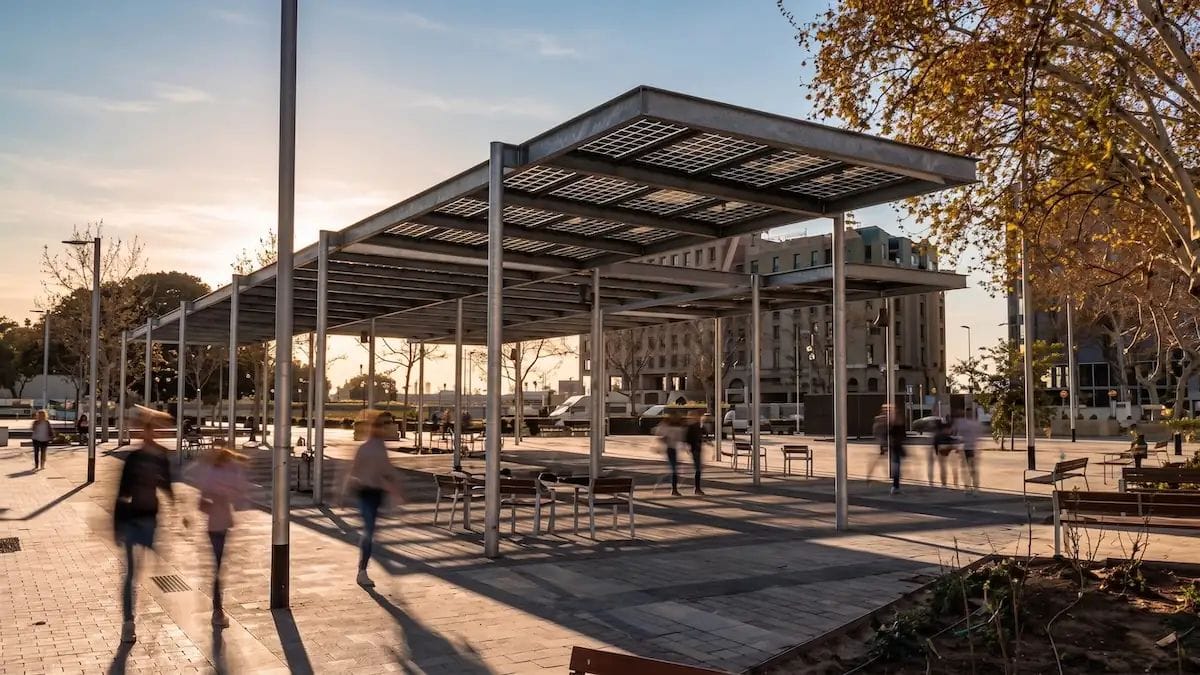
The installation is at the junction of Cal Cisó and Conesa streets and covers around 190 square metres. It has an output of 31.6 kWp and is estimated to generate around 31,600 kWh a year, an amount approximately equivalent to the electricity consumption of 14 homes.
The energy will not be used only within the park. Thanks to a grid-connected shared self-consumption system, production will be distributed between the Centre de Barri El Polvorí, the Casal de Gent Gran El Polvorí and the Casal de Barri La Vinya. The work cost exactly 408,521 euros, including VAT, and was carried out by the Institut Municipal d’Urbanisme. According to municipal estimates, the electricity produced will make it possible to avoid around 11.4 tonnes of CO₂ emissions each year.
The pergola also has a particularly visible function during the hot months. Beneath the panels, a seating area with benches and permanent shade has been created in an area where there are still few trees. This lack of tree cover also helps the panels receive more solar radiation.
The project is part of the development of Marina del Prat Vermell, one of Barcelona’s neighbourhoods changing most through the construction of homes, new facilities and public spaces. The Parc de les Tretze Roses, opened in 2024, includes almost 4,370 square metres of new green space within an urbanised area of almost 21,000 square metres.
The City Council wants such installations to be incorporated increasingly into new urban projects, so that ordinary elements such as roofs or pergolas can fulfil several functions at the same time. In this case, the same space that protects people from the sun on an August afternoon will generate electricity for the facilities used daily by neighbourhood residents.