
News
Barcelona tests three paints to reduce heat in buildings
This summer, Barcelona will try out a solution that seems simple but has the potential to improve comfort inside buildings: painting rooftops with materials that can reflect more solar radiation and absorb less heat. The experiment will begin in Les Corts, on the roof of Institut Escola Tres Fonts.
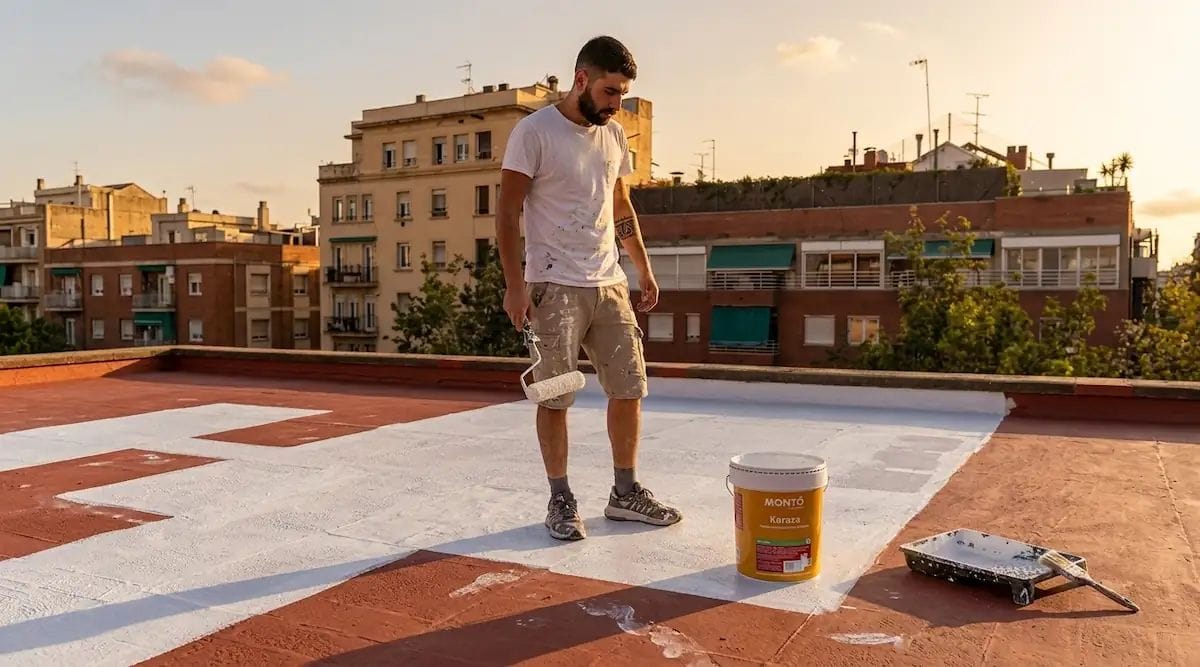
The aim is to determine whether certain types of paint can reduce the indoor temperature of buildings without altering the traditional appearance of Barcelona's rooftops. The idea is not to cover everything in white, but to find solutions that cool without breaking with the city's usual aesthetic.
The trial will compare three different finishes: white paint, conventional terracotta and terracotta with reflective pigments. The latter is one of the most interesting options because it seeks to retain the characteristic colour of many roofs while improving their performance in the sun.
The problem is becoming increasingly evident. In summer, roofs receive many hours of radiation and can become a source of heat transmitted into homes, schools and facilities. In poorly insulated buildings or those with little ventilation, this build-up worsens rest and increases the need for cooling.
The experiment also seeks to measure whether these paints help reduce energy consumption. If a roof heats up less, the building needs less air conditioning to maintain an acceptable temperature, something important in a city where heatwaves are more frequent and tropical nights leave increasingly less room for recovery.
The trial will be completed at Vibrantz Technologies facilities, where two identical huts painted with conventional terracotta and reflective terracotta will be used. Both will have their air conditioning limited to 27 degrees, which will make it possible to compare electricity consumption and determine whether the innovative paint reduces demand for cooling.
Technicians will also analyse the potential of radiative cooling, a passive process that allows some surfaces to release heat outwards, especially on clear nights. This mechanism may be key to ensuring that buildings not only heat up less during the day, but also lose heat more easily at night.
Monitoring will be carried out with sensors measuring temperature, humidity, solar irradiance and electricity consumption. The intention is to have real data before deciding whether these solutions can be extended to more roofs, schools, facilities or urban refurbishments.
The initiative forms part of the municipal strategy to adapt Barcelona to extreme heat. The Pla Calor includes measures to reduce the heat-island effect, improve thermal comfort and protect the population in a dense city with a great deal of asphalt and buildings that were not always designed for such harsh summers.
In neighbourhoods such as Les Corts, the experiment may seem small, but it points to an important question: how to make buildings more liveable without major works and without driving up energy costs. Painting a roof will not solve climate change on its own, but it may be one more part of the city's everyday adaptation.
Barcelona is thus seeking solutions that do not remain just grand plans on paper. If the results work, rooftops could become allies against the heat: unobtrusive surfaces, visible from above, but decisive in making it possible to live better inside a home, school or facility when the thermometer rises.