
News
Carabanchel transforms its pulse: art, youth rental housing and new urban life
Carabanchel is changing pace: an artistic micro-neighbourhood in Opañel will add youth rental housing and new urban life
Update — 5 March 2026
Kronos’s project in Opañel continues to move forward, and Carabanchel remains in Madrid’s urban and cultural spotlight. We are updating the piece with context and keys to understanding what may change in the neighbourhood and why this plan is generating discussion.
In Carabanchel, Antoñita Jiménez Street and its surroundings are beginning to leave industrial silence behind. Where workshops and closed warehouses once predominated, cranes now rise and hammers can be heard. The Opañel neighbourhood, traditionally working-class and discreet, is becoming the setting for one of Madrid’s most distinctive urban transformations. Kronos Real Estate, after five years of acquiring buildings and plots on seven streets, is promoting an artistic micro-neighbourhood that combines rental housing and spaces for creation.
The plan is ambitious: 25 buildings, of which 15 will be refurbished and 10 completely new. Brick, present on most façades, will serve as the thread linking the old and the contemporary. Many original industrial structures will be preserved, such as the former Cocinas Cobo factory, which will now be integrated into the new urban landscape. Kronos and its group of investors plan to allocate more than 150 million euros to this development, with the intention of preserving the essence of the neighbourhood while attracting new residents and creators.
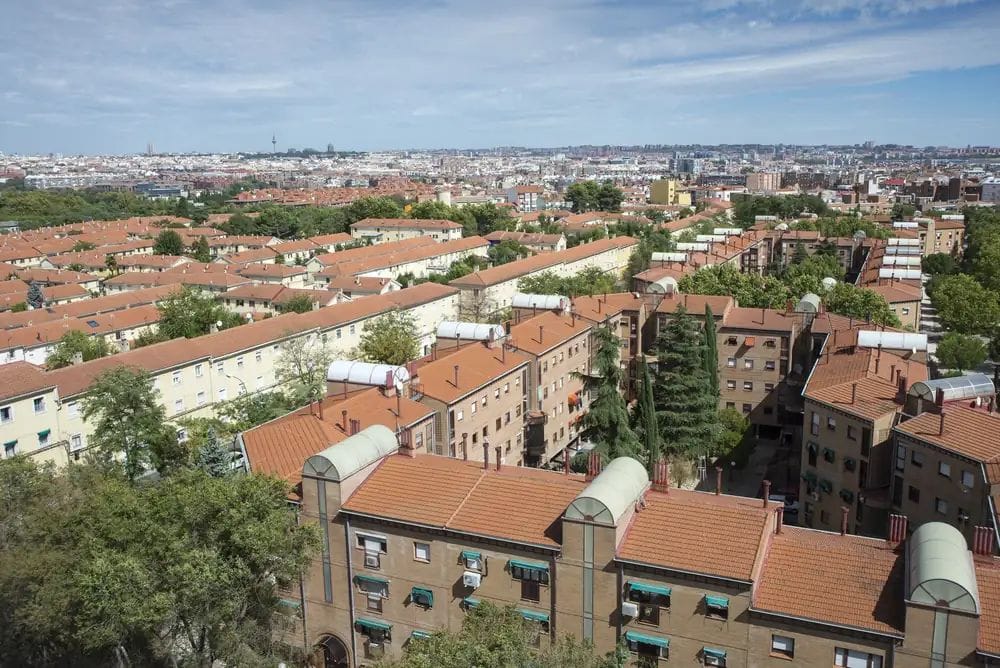
From the rooftop of Pedro Campos 6, the city opens up brightly, while below the neighbourhood shows empty plots, recently demolished walls and machinery in motion. Construction progresses unevenly from number 3 to 62 on Antoñita Jiménez. There, a former coach depot has already become the studio of a Mexican sculptor. The project covers 38,000 square metres and, when it is completed in around seven years, will add more than 300 rental homes, many intended for young people and with moderate prices.
The project’s singularity also lies in its authorship: ten of the new buildings will bear the signature of renowned architects, including two Pritzker Prize winners. Five will be located on Antoñita Jiménez and the others on nearby streets such as Fernando González, Antonio González Porras and Miguel Mayor. The first building, designed by Juan Herreros, will have 74 homes, a swimming pool and common areas, organised around interior gardens visible from the street. This layout will be repeated in the other new buildings.
Among residents, feelings are mixed. Some, such as Juan, watch the works with fatigue because of the inconvenience, but also with hope of seeing the neighbourhood renewed and more lively. Others, such as Raquel, an architect and resident for eight years, fear that the arrival of new profiles and services will make the area more expensive and dilute its traditional atmosphere. However, the cultural life and artistic effervescence already visible in galleries and studios encourage many to stay and take part in the change.
The first phase, with 150 homes, will be ready in spring 2027. The first tenants will arrive this year at Antoñita Jiménez 3, with prices of around 1,200 euros for one bedroom and 1,400 for two. At Fernando González 1, the flats designed by Langarita Navarro will be delivered in the coming months. Little by little, the neighbourhood adjusts its rhythm and prepares for a new stage in which art and housing for young people will set the daily pulse.
Carabanchel, especially Opañel, has lived several lives: from industrial enclave to refuge for artists and now a laboratory of urban coexistence. Its diverse, resilient social fabric has known how to adapt to change without entirely losing its character. The arrival of projects such as this confirms a trend: Madrid is already beginning to move in that direction, where mixed uses and a commitment to culture redefine the city from its neighbourhoods.
Carabanchel is at a delicate point. The arrival of new rental housing and the consolidation of the creative ecosystem may bring more life to the neighbourhood, but also tensions over prices, identity and coexistence. At DondeGo, we follow these transformations because they affect residents’ real day-to-day lives: from local commerce to access to housing for young people and the kind of city Madrid is building from its districts.