
News
The rise of quiet leisure in Madrid: why more Madrid residents are choosing calm social experiences in 2026
Madrid is noisy. It always has been. Dinners at ten at night, terraces occupying pavements long after midnight, three conversations crossing at the same time amid the noise of chairs and traffic; that is the city's natural state, and most people who live here would not change it for anything. That is why it is somewhat strange to observe what has happened over the last year.
More and more people in Madrid are opting for less. Less noise, fewer notifications, smaller groups, plans organised with intention rather than arising through inertia. No one is asking for the whole city to keep quiet. Vermouth bars are still full and Malasaña is not going to go dark when night falls. But alongside all that familiar bustle, something much calmer has begun to claim its own space. And, curiously, it is working.
People are tired of noise that never stops
Speak to enough residents and you will hear some version of the same complaint: by the time Friday arrives, they are already exhausted and the weekend has not even begun.
Part of the problem is that work has crept into every sphere of life. Hybrid schedules erased the line separating the office from home long ago, and almost no one is completely disconnected any more. Even leisure has begun to feel like a performance: every dinner, every rooftop gathering seems like a secret audition for social media.
That is why it is no surprise that people are looking for alternatives.
There is also a parallel trend. That same desire to disconnect digitally is leading many people to take an interest in online privacy and question their technology habits. Consult this introductory guide to ExpressVPN, a resource that often comes up precisely in this kind of conversation among people trying to recover some sense of personal space on the internet, gradually and through small everyday changes.
To be clear, nobody is throwing their phone into the river. People are simply becoming more selective: when to connect, where to do it and how much time to devote to it.
And that selectivity has begun to carry over into how free time is enjoyed.
Now, talking is optional
Silent book clubs are probably the clearest example.
They have been appearing in cities around the world, and Madrid has been no exception. The format can barely be called a format: turn up at a café, a bookshop, a park or any cultural space willing to host the initiative, read on your own for one or two hours and talk afterwards if you feel like it. No compulsory book. No obligation to speak.
For some it sounds antisocial. For others, exactly the opposite.
And that is precisely the key. People still need community, but they are tired of the version that requires three straight hours of forced, loud conversation. A silent book club offers company without conditions.
Creative workshops are evolving in the same direction. Ceramics studios, analogue photography meet-ups, urban sketching groups and embroidery circles are much busier than they were a few years ago. Conversation still exists, of course, but it is secondary. The activity fills the room.
Nobody considers silence uncomfortable. In fact, that is a large part of its appeal.
A slower rhythm has settled into the city
Madrid is not the only place where this is happening, although it is especially striking in a city whose identity has always been so closely tied to noisy sociability.
Writers, sociologists and cultural analysts have long been circling around the same idea: a return to contemplation and to slower, more deliberate ways of being present. Spanish media have even described contemplation as the world’s slowest cultural revolution, reflecting the extent to which this change is beginning to be taken seriously.
The signs are everywhere once you begin to notice them.
Museums are organising guided meditation sessions. Botanical gardens offer mindful walks. Independent cinemas combine early screenings with relaxed conversations afterwards, instead of the usual networking events. Even some cafés have begun to reserve quiet time slots.
A few years ago, all this would have seemed like a curiosity for only a few people.
Now it no longer does. Not at all.
The city itself is helping more than it seems
Part of the reason this trend works so well in Madrid is that the city was already prepared for it, although nobody had noticed until recently.
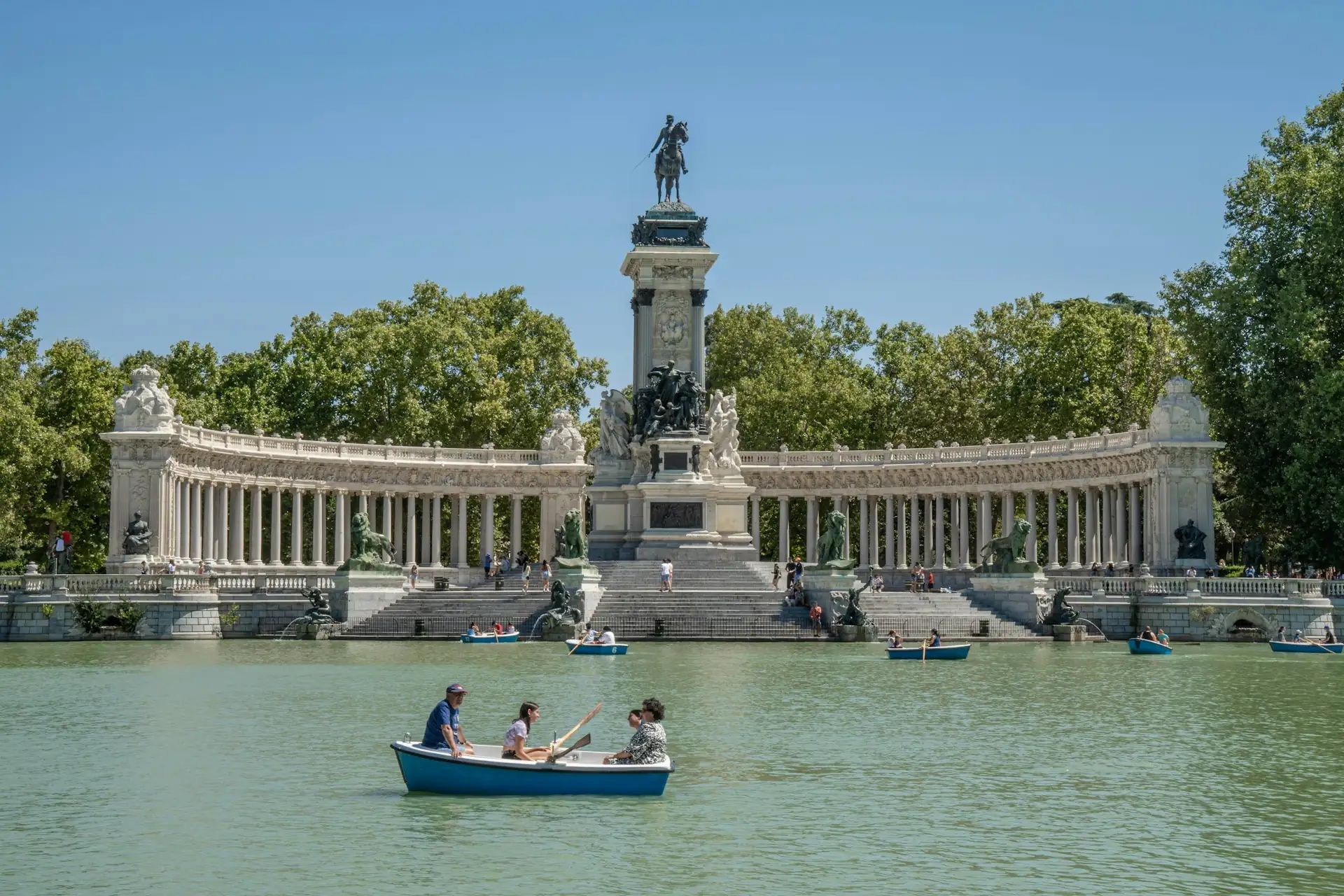
El Retiro is the clearest example. Some areas on weekdays, especially in the morning, are surprisingly quiet. But this search for calm goes far beyond the best-known places. Neighbourhood cultural centres, hidden courtyards, historic libraries or riverside paths that almost nobody uses on an ordinary Tuesday have become refuges for people looking for company without overstimulation.
Interest is also growing in small getaways that do not require leaving the city. Instead of booking a weekend trip, many residents seek brief moments of disconnection close to home. If this idea interests you, our article on how to slow down in Madrid when the clocks change explores various local experiences designed precisely to slow down.
There is real demand for this kind of leisure, and it does not seem likely to disappear.
Silence does not mean solitude
The biggest mistake in interpreting this trend is to think that it is about isolation.
Most people who take part in this type of activity would say exactly the opposite.
Traditional socialising often comes with expectations: keeping the conversation going, managing the group, staying longer than desired and constantly responding to everything. Calmer formats remove much of that pressure.
You can spend an afternoon drawing, walking or reading alongside strangers and still feel more connected than after a noisy night, without having to play any social role.
That flexibility is especially important for younger generations.
Generation Z and younger millennials seem comfortable with friendships that do not require constant contact. Spending two hours reading in silence beside a friend does not seem strange to them. For some, it is even a sign of real closeness.
A friend once described it as «parallel play for adults». And, honestly, the definition is uncomfortably accurate.
Not every night has to be unforgettable
Madrid’s nightlife is not going to disappear. Nobody is giving up terraces, festivals or those nights that end at three in the morning without anyone having planned them.
But a quiet idea does seem to be growing: leisure does not have to be intense to be satisfying.
Sometimes, a bench in a park, a novel and several people doing exactly the same thing are enough.
Sometimes, shaping clay in almost complete silence is far better than spending another night in a packed bar.
And sometimes, the most social gesture of all is simply sharing space with other people without saying much.
For a city as noisy as Madrid, it is a curious change. Perhaps even a positive one.