
News
Madrid will demolish the old Corte Inglés de Méndez Álvaro to create a large park and ...
The Nuevo Sur-Méndez Álvaro project will transform the old shopping centre into a large green area, an underground mobility hub for Bicimad, and an office tower, redefining one of the strategic points in the south of Madrid.
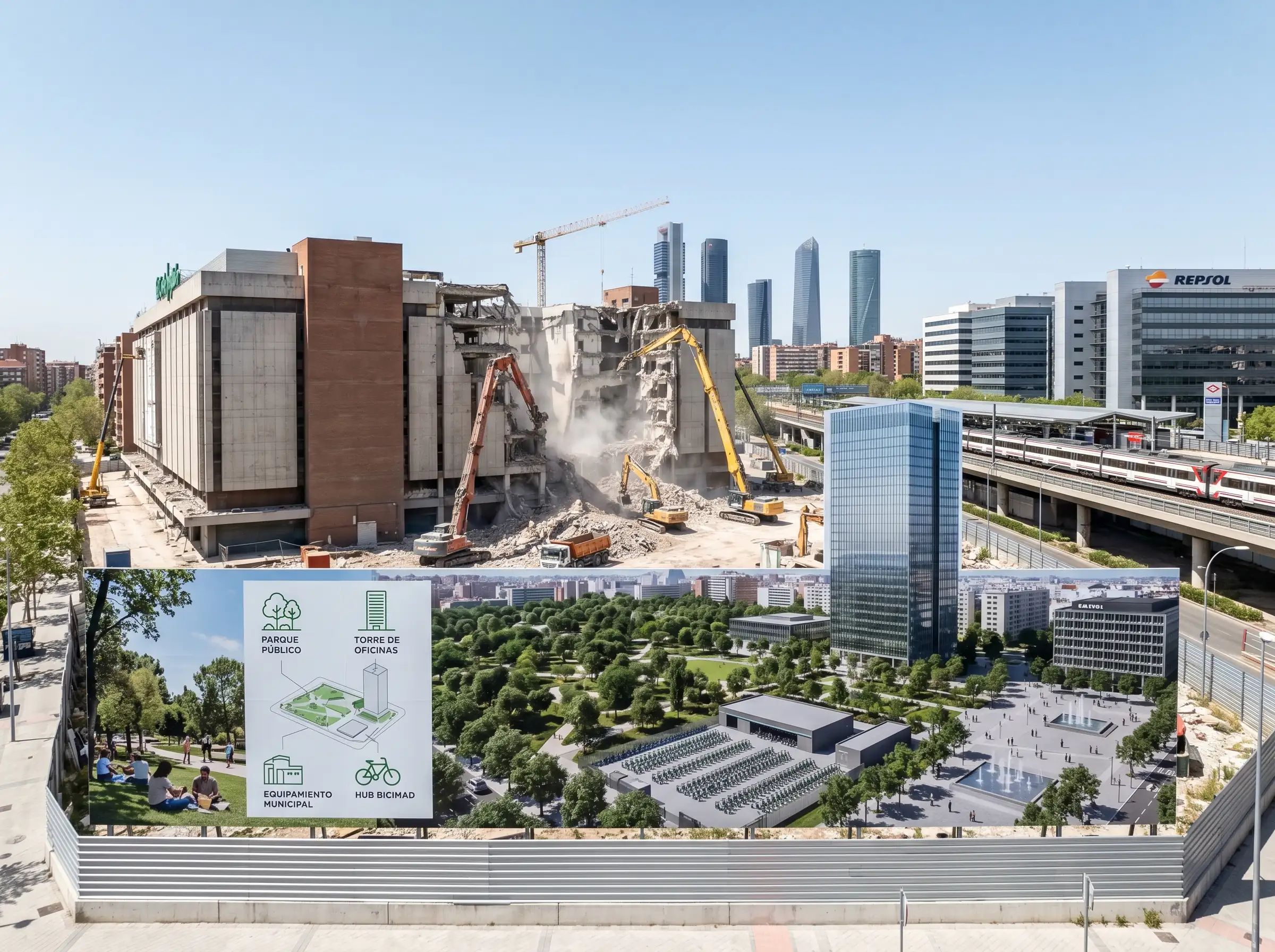
The former El Corte Inglés in Méndez Álvaro will be demolished. In its place there will be a large park, a mobility centre for Bicimad and an office tower. The change will affect daily life and the landscape of southern Madrid.
The definitive closure of the former El Corte Inglés in Méndez Álvaro marks the start of an urban transformation that will change life in southern Madrid. The building, which for decades was a commercial landmark and meeting point, will give way to a new space where mobility, green areas and economic activity intertwine.
The City Council has approved the urban planning agreement that activates the Nuevo Sur‑Méndez Álvaro project. The plot, of almost 12,000 square metres, is now divided between 72% municipal land —for public facilities and a park— and 28% privately owned land for offices. The historic shopping centre, opened in 1992 and closed in 2024, will be demolished within 18 to 24 months of final approval. Cranes and earthmoving will be visible in the neighbourhood over the next two years.
Most of the land, now in municipal hands, will become a large district green area and a public facility still to be defined, which will be specified in dialogue with the Junta de Arganzuela and local residents. Deputy Mayor Inma Sanz has said that the park will be the central axis of the new space, around which the public buildings and future office tower will be arranged. The aim is to create new pedestrian connections and places to linger in an environment hitherto dominated by traffic and closed commercial use.
Below ground, the former El Corte Inglés underground car park —with around 28,000 square metres— will be transformed into a Mobility Centre run by the Empresa Municipal de Transportes. The new Bicimad operations and maintenance base will be installed there, with capacity to manage up to 9,000 public bicycles. In addition, there will be a municipal tow-truck base with 1,200 spaces for removed vehicles, a 320-space public short-stay car park and an electric mobility hub for professional fleets and the charging of zero-emission vehicles. The City Council thus seeks to turn Méndez Álvaro into a key sustainable mobility hub, taking advantage of its strategic position next to the train, bus and Metro station.
On the private plot, of 3,311 square metres, an office tower of up to 27 storeys will be built. This new skyscraper, with a maximum buildable area of 51,776 square metres, aims to become a landmark on southern Madrid’s skyline and a centre of attraction for businesses and employment. The operation is part of the municipal strategy to consolidate the southern M‑30 axis as a new business centre, in line with other recent developments in the area.
Méndez Álvaro has undergone an accelerated transformation in recent years, moving from a transit area to becoming one of Madrid’s most dynamic urban hubs. Its proximity to the M‑30, the intermodal station and new office developments have changed the rhythm of the neighbourhood. Now, with the arrival of a large park, new facilities and a tower redefining the horizon, the area adjusts its pulse again and prepares for a new stage in the city’s life.
🆕 Demolition of El Corte Inglés Méndez Álvaro approved. Nuevo Sur-Méndez Álvaro brings a park, Bicimad (9,000 bikes), tow truck, electric hub and 27-storey tower; 72% municipal, demolition in 18–24 months. Transformation of southern Madrid: 11,811 m² in Arganzuela move from retail to green space, sustainable mobility and offices; EMT runs underground centre, Inma Sanz drives M-30 hub.