
News
Madrid faces its worst fire in decades with thousands evacuated
The southwest of Madrid is experiencing one of the most serious fires in recent decades, with thousands of residents out of their homes and several municipalities awaiting new evacuation orders. The merging of three separate outbreaks has created a highly intense front that is advancing, driven by wind, heat, and dry ground conditions.
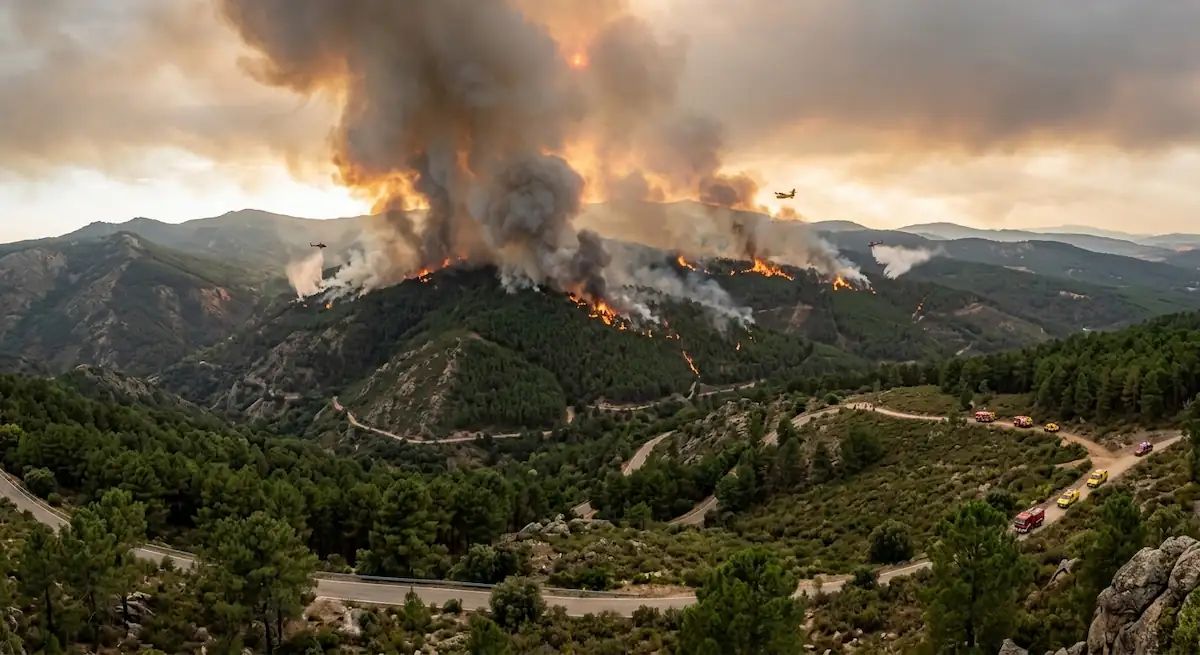
The situation worsened as temperatures above 30 degrees coincided with humidity below 30% and wind gusts of more than 30 kilometres per hour. That combination, known as the 30-30-30 rule, encourages flames to spread rapidly and reduces the room for manoeuvre available to emergency teams.
Within a few hours, the affected area grew from about 600 to around 6,000 hectares, while the number of people evacuated or confined exceeded 45,000. Chapinería, Navas del Rey, Colmenar del Arroyo, Fresnedillas de la Oliva, Robledo de Chavela, Aldea del Fresno, Navalagamella and Zarzalejo are among the evacuated municipalities.
In Villa del Prado, San Martín de Valdeiglesias and Pelayos de la Presa, residents remain confined while they wait for the situation to improve. The restrictions have closed roads, halted journeys and completely disrupted routines in an area heavily visited during summer weekends.
Firefighters explain that the difficulty does not lie solely in the amount of resources deployed. The main fire front is advancing so quickly and releasing so much heat that attacking it directly is too dangerous. Work is focused on protecting homes, opening up safe areas and containing the flanks when the wind provides an opportunity.
Property damage is already significant. In El Encinar del Alberche, 43 homes have been counted as destroyed and nearly 300 affected, while inspections continue in other residential developments. There is also concern that the fire coming from Ávila could approach the Madrid front and create an even more extensive emergency.
The scale of the operation has led many personnel to cancel their rest periods and reinforce shifts. Professionals point to the build-up of dry vegetation and a lack of maintenance in some areas as factors that have accelerated the spread following a rainy winter and several weeks of extreme temperatures.
Forecasts indicate the arrival of slightly cooler, more humid air, although the wind will remain decisive. The scene is one of empty towns, closed roads and residential developments watching the skies, while thousands of people wait to return home without the flames changing direction again.