
News
The Vallecas spot prepared for watching the eclipse and the Perseids
La Gavia Park hides one of the most distinctive spots for looking at the sky without leaving Madrid. Its stellar viewpoint, in an elevated area of Ensanche de Vallecas, combines open views, astronomy and an educational route designed for residents, families and curious people of all ages.
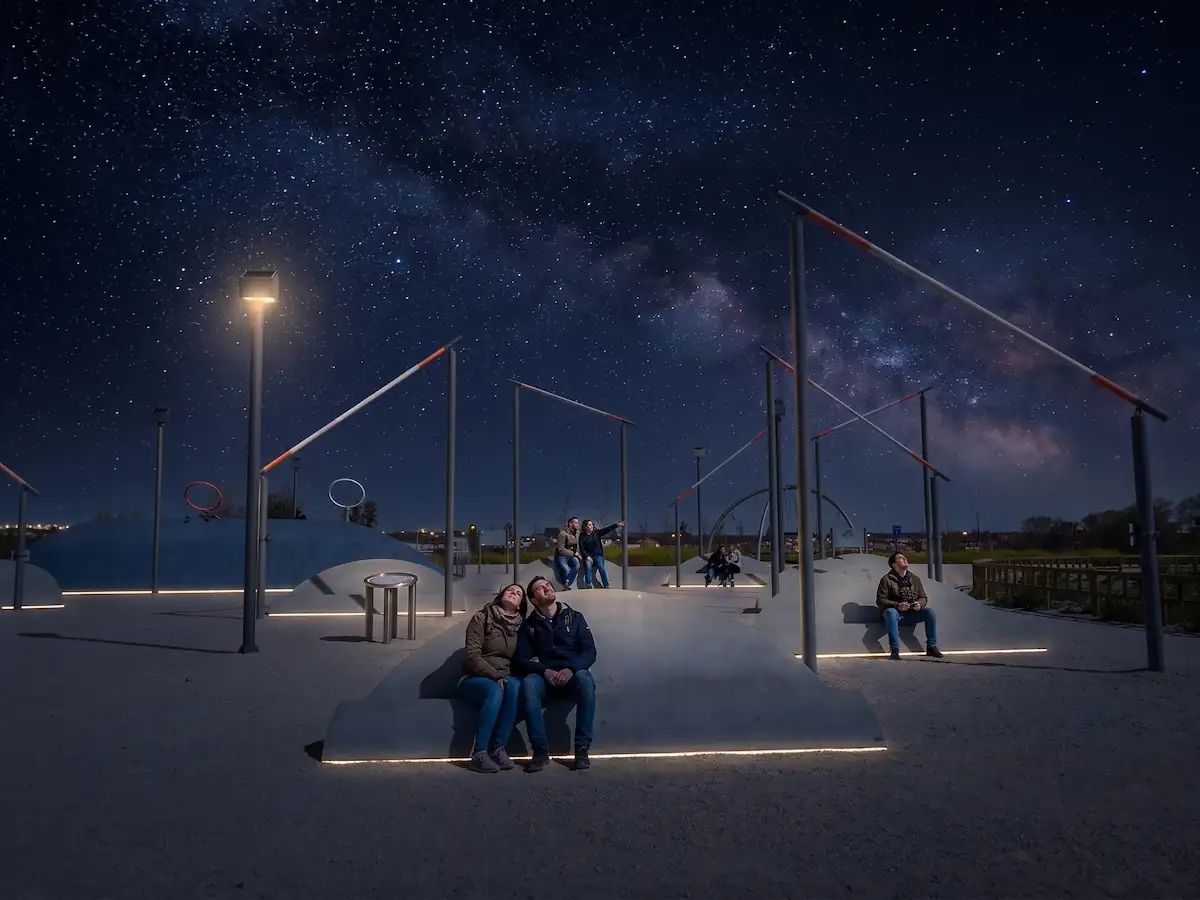
The space has twelve benches dedicated to the signs of the zodiac. Their orientation helps direct the gaze towards different areas of the firmament, turning a pause during a walk into a simple way to begin recognising constellations.
The design is completed by structures that make it possible to draw imaginary lines between stars and by celestial planispheres for identifying what can be observed at each time of year. The explanatory panels also show how the night sky and its visibility change according to the season and light pollution.
The proposal requires no prior knowledge or special equipment on an ordinary night. It is enough to sit down, let your eyes adapt to the darkness and follow the lookout’s own directions to better understand the position of the stars.
The site takes on particular interest ahead of the solar eclipse on 12 August. Its elevation and the relatively unobstructed horizon to the west may make it easier to observe the phenomenon at sunset, although it will be essential to use approved glasses and never look directly at the Sun without proper protection.
When the eclipse ends, attention can turn to the Perseids, whose peak activity will coincide with those dates. No filters or telescopes are needed to observe shooting stars: the most useful thing is to find a dark area, avoid screens and look at a broad area of the sky.
Madrid’s light pollution will make the faintest meteors impossible to see, but the expanse of La Gavia offers better conditions than many streets in the centre. Those seeking a more complete experience can bring a blanket, water and something warm in order to stay outdoors for several hours.
The lookout forms part of a 36-hectare park, with more than 3,000 trees and an extensive network of paths. The scene leaves benches facing the stars, local residents learning to find their bearings and a corner of Vallecas where the city seems to step aside for a few minutes to make room for the sky.