
News
Las Cortes health centre preserves the place where cinema was born in Spain
In a waiting room at Las Cortes health centre, while patients look at their phones or wait to be called over the public-address system, an unlikely story beats. There, in the basement of the former Hotel Rusia, Madrid residents saw the Lumière brothers’ cinematograph for the first time 130 years ago. What is now a healthcare space was, for a few days in May 1896, an open door to a new way of seeing the world.
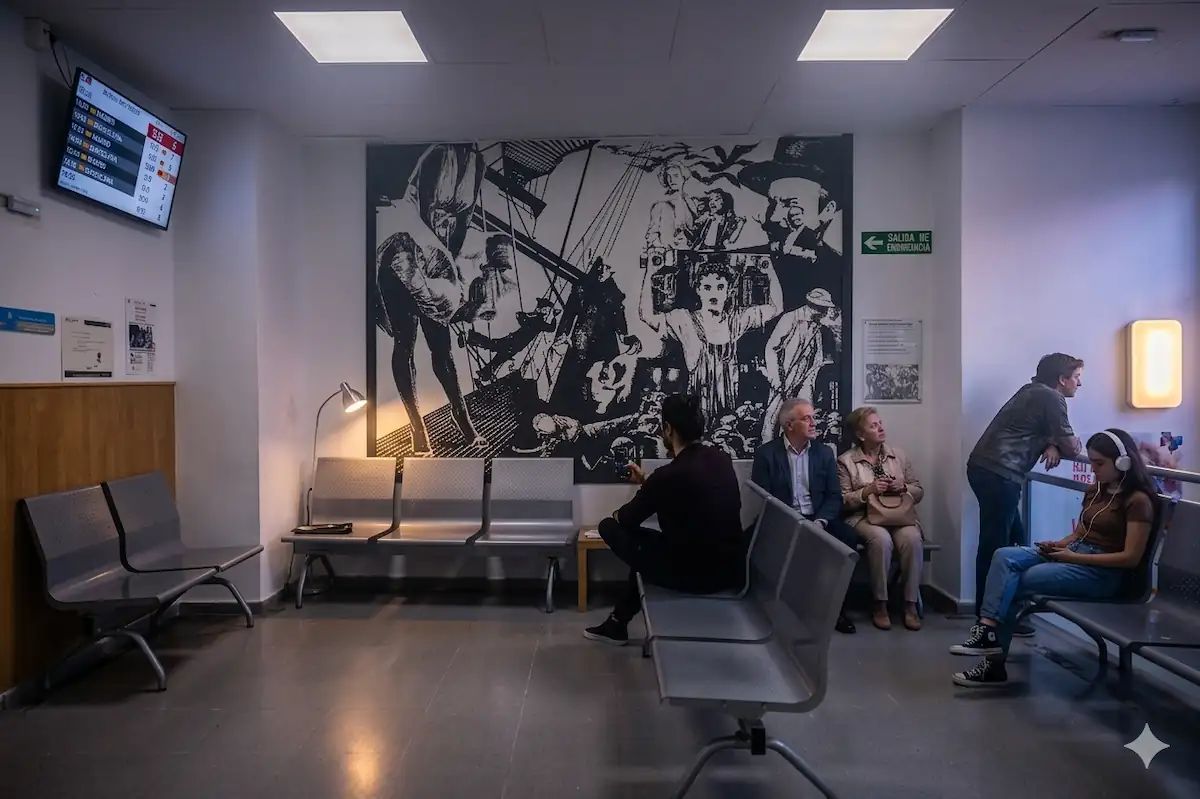
The building stands right on Carrera de San Jerónimo, between Casa Mira and the Congress of Deputies. Its current routine does not invite one to imagine that premiere: appointments, records, waiting chairs and quick steps along the corridor. But a black-and-white mural and several plaques recall that the first “animated photographs” to reach Spain were screened in that very place.
The exact date has prompted debate for decades. Some plaques mention 14 or 15 May, but recent research places the first screening on 13 May 1896, reserved for the press and invited guests, with the public opening the following day. The cinematograph had only just triumphed in Paris a few months earlier, and Madrid was one of the first cities to be dazzled by that invention.
The experience cost one peseta and promised something difficult to explain at the time: seeing trains, workers, streets and everyday scenes move across a screen. Madrid had already known earlier devices, such as Edison’s kinetoscope, but the difference was enormous. The cinematograph turned looking into a collective act. It was no longer a matter of looking alone through a machine, but of sharing the astonishment with other spectators.
The operator Alexandre Promio, sent by the Lumière house, played a key role in those early days. As well as presenting the films, he shot some of the first moving images in Spain, with urban and court scenes that helped turn Madrid into a setting for the new visual language.
Over time, the Hotel Rusia disappeared and the premises changed use. It was a shop, then a transformed space, and finally a health centre. Even so, the building retains architectural details and signs of memory that recall that Spanish cinema was not born in a grand, solemn hall, but in a ground-floor premises in central Madrid, amid traffic, shops and everyday life.
The story gains strength precisely from that contrast. Where audiences once marvelled at an image of a train arriving at the station, local residents today wait for a prescription or a medical appointment. The place has not been frozen as a museum: it still works, it is still useful, it is still full of people. And perhaps that is why it better preserves the mark of that moment.
Las Cortes is one of those neighbourhoods where Madrid mixes layers without asking permission: politics, century-old commerce, tourism, literature, cafés, offices and now also the origin of cinema. The next time someone waits their turn at that health centre, they may look at the mural differently. Because sometimes the memory of a city is not in a grandiloquent plaque, but in a waiting room where almost nobody imagines that a revolution began.