
News
The Marina bridge is finally refurbished after years hidden beneath nets in Barcelona
The Marina bridge, key to mobility in Barcelona, begins its long-awaited refurbishment after 12 years covered by nets. Works begin in September and aim to restore its splendour for its centenary. Traffic will not be closed during the works.
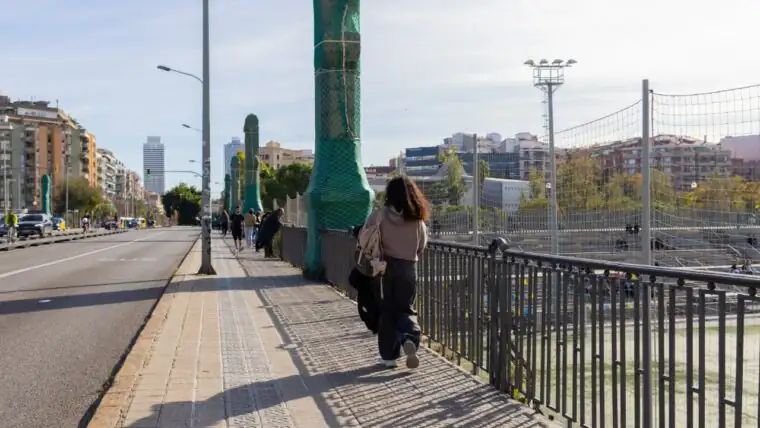
Marina Bridge, key to mobility in Barcelona, is beginning its long-awaited refurbishment after 12 years covered by netting. Work starts in September and aims to restore its splendour for its centenary. Traffic will not be closed during the works.
Photo by estaticos-cdn.prensaiberica.es
Those who cross Marina Bridge every day have seen for years how netting covered its pillars, recalling the deterioration of infrastructure essential to the city. After more than a decade of temporary solutions, Barcelona City Council has decided to act: the long-awaited comprehensive refurbishment of the viaduct will begin in September, with the aim of having it looking renewed for its centenary in 2028.
The bridge, located in the Fort Pienc neighbourhood, connects Port Olímpic with Sagrada Família and carries a constant flow of vehicles and cyclists. Since 2014, the original columns from 1928 have remained wrapped in mesh to prevent pieces from falling, an image that has become familiar in the urban landscape. Now, the municipal intervention promises to restore and reinforce the structure, finally removing the protections that have marked its silhouette for 12 years.
The refurbishment, to be carried out in phases, will make it possible to keep traffic open at all times. The plan provides for longitudinal closures so that at least one lane remains available in each direction, as well as the two-way cycle track. In addition to repairing structural damage, lighting and traffic lights will be renewed, and anti-pigeon netting will be installed beneath the footbridge, where a park and sports facilities are located.
The total budget for rehabilitating Marina Bridge amounts to six million euros, within a wider municipal investment that also includes restoring Vallcarca Bridge and refurbishing the façades of the former Renfe workshops in Clot. The City Council justifies the long wait by the high cost and the need to prioritise comprehensive city maintenance, which now has a specific plan and resources unprecedented in previous terms of office.
The intervention aims not only to restore the bridge’s original appearance, but also to guarantee its durability through preventive maintenance that extends its useful life. Residents and users will be able to continue crossing the viaduct during the planned 14 months of works, although they will have to adapt to temporary changes in traffic.
Marina Bridge is much more than a thoroughfare: it is part of Barcelona’s urban memory and has witnessed the transformation of its surroundings since its inauguration in 1928. Its design responds to the need to connect two key parts of the city, facilitating access between the waterfront and the Eixample. Over the years, it has borne the growth of traffic and the evolution of the neighbourhood, becoming a symbol of mobility in Barcelona. The forthcoming refurbishment is an opportunity to recover its heritage and functional value in the heart of the 21st century.