
News
Puente de Vallecas will gain green areas and pedestrian space beneath the scalextric
One of Madrid's harshest and busiest spots is about to change its appearance. The City Council will invest 11.5 million euros to transform the area around the well-known Puente de Vallecas scalextric, an area marked for decades by traffic, noise and the sense of a border between neighbourhoods. The project promises more pedestrian space, green areas and a less aggressive image for those who live in or travel daily between Retiro and Vallecas.
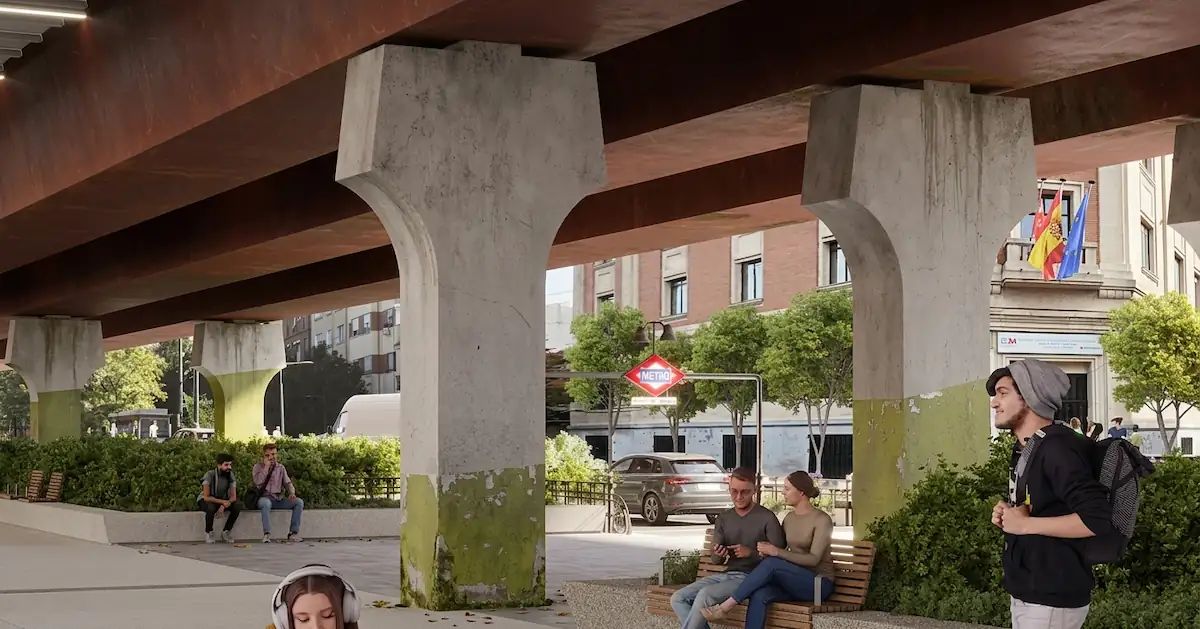
The work will directly affect the everyday lives of thousands of residents who pass beneath the bridge every day or use the connections between Avenida de la Albufera, the M-30 and Avenida de la Paz. The municipal objective is to reduce the visual and urban impact of the flyover without, for now, putting it underground, a long-standing neighbourhood demand that the Ayuntamiento still considers unfeasible in the short term.
The project includes pedestrianising several areas beneath the bridge and reorganising bus stops to make it easier for people to pass through. New pedestrian crossings, landscaped areas and spaces for lingering with continuous benches will also be created. According to the council, pedestrians will gain more than 3,700 square metres in one of the most hostile areas for walking in the city.
The transformation will also seek to soften the infrastructure's grey landscape with vertical gardens along 750 metres of the M-30, paint in green and blue tones and new noise barriers. In addition, dozens of trees and thousands of shrubs will be planted in an attempt to reduce the feeling of permanent asphalt that currently dominates the surrounding area.
Work will begin this summer and continue until early 2028. During that time, the neighbourhood will live alongside work to renew paving, lighting and street furniture. New municipal spaces will also be built beneath the bridge, although the use of some of them has not yet been fully specified.
The intervention has also reignited the political debate over the future of the flyover. The opposition insists that the underlying problem will not be resolved without demolishing or putting the structure underground, while the Ayuntamiento argues that this is the only viable transformation at present.
The Puente de Vallecas bridge is not merely traffic infrastructure. For many residents, it represents decades of urban division, pollution and physical barriers between historically connected neighbourhoods. Its transformation also reflects how Madrid is beginning to rethink some of the major spaces built around the car and is seeking to reclaim part of the city for pedestrians, neighbourhood life and more people-friendly mobility.