
News
Museu del Rock reinvents itself on Portaferrissa with legendary guitars
Barcelona has a new refuge for those who want to see music up close, almost with their hands. Museu del Rock, on Portaferrissa street, a few steps from La Rambla, has renewed its offering to become a more immersive, visual experience designed for very different audiences.
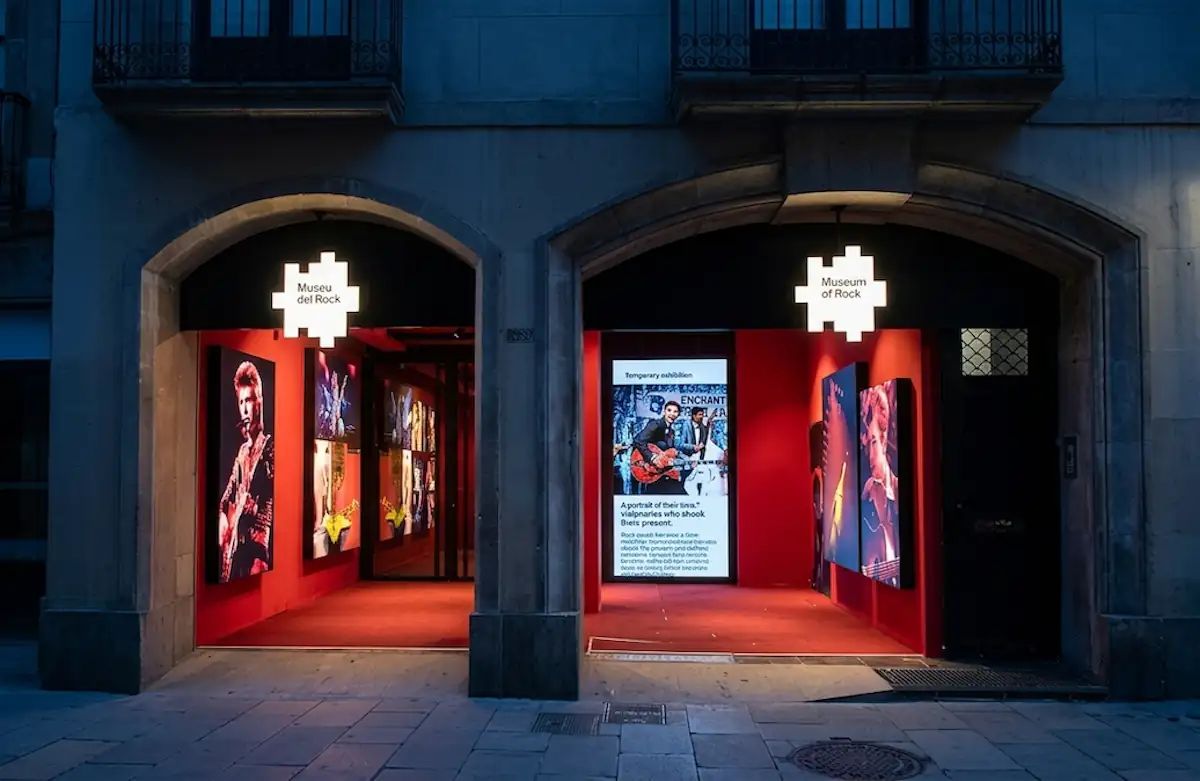
The venue was founded in 2024 as Guitar Legends Hall, but it now operates with a broader ambition: not only to display instruments, but to explain how rock has spanned generations, fashions, social conflicts and ways of experiencing popular culture. The guitar remains the main thread running through it, but it no longer appears as a mere display-case object.
The collection brings together guitars and basses linked to key names in the genre. There are pieces related to Gary Moore and Thin Lizzy, David Knopfler of Dire Straits, Cliff Williams of AC/DC, Joe Perry of Aerosmith, Steve Vai, Slash, Paul Stanley, Dave Mustaine, Orianthi and Lupe Villar, among other artists who have shaped decades of music.
Its appeal lies in the fact that each instrument comes with context. Videos, songs, explanations and audiovisual material help explain why a guitar matters, what moment it represents and how it connects to a scene, a tour, a sound or an entire generation.
The visit is not conceived as a silent tour. The museum is committed to an interactive experience, with more than six hours of audiovisual content and an audio guide that lets visitors move unhurriedly through decades of rock, from its roots to the era of large stadiums, festivals and MTV.
The tour includes themed spaces that recreate key moments in rock culture. There are references to the birth of the genre, the explosion of the 1960s, mass concerts and music television, as well as a replica rehearsal garage that connects directly with the most classic imagery of bands.
One of the most eye-catching elements is the immersive section, with holograms and staged recreations that bring the museum closer to younger visitors. For those who did not live through those decades, the proposal seeks to ensure that rock does not seem like a relic, but something alive, loud and still recognisable.
Behind the collection is Juan José Castellano, collector and driving force behind the project. His work does not consist only of gathering guitars, but of verifying origins, details, marks, dents and elements that can demonstrate that every piece has a real story behind it.
That work matters especially in a market where pieces linked to great musicians can reach very high prices and where forgeries are not unusual. At the Museu del Rock, authenticity is as much part of the story as the sound.
The new stage also includes a space for temporary exhibitions. The first, “Ahead of Their Time”, uses the universe of Back to the Future as a starting point to discuss artists who were ahead of their era, from Tony Iommi, Pink Floyd or Led Zeppelin to The Velvet Underground, The Beatles, David Bowie or Nina Hagen.
Among the most curious pieces is a Gibson ES-345 like the one Marty McFly plays in the famous scene of “Johnny B. Goode”, as well as objects associated with the imagery of the film. The exhibition plays with that very rock-and-roll idea of being ahead of the curve, sounding strange at first and ultimately leading the way.
The average visit is around an hour and a half, making the museum a manageable plan for an afternoon in the centre. It may work for rock lovers, families, tourists looking for something different near La Rambla, or local residents who want to rediscover a street they may pass through without looking too closely.
The location helps. Portaferrissa is one of those streets where Barcelona mixes commerce, tourism, history and constant movement. Amid that bustle, the museum offers a sonic pause: enter from a street full of people and find guitars, riffs, screens and musical memory.
The project also aims to have an educational dimension. The Museu del Rock presents itself as a space for schoolchildren and new generations, with the idea of explaining the 20th century through songs, youth movements, aesthetic rebellion and social change.
The shop completes the experience with books, records and objects related to rock culture. It is not merely an outing driven by nostalgia: it is also a way to approach a language that remains present in T-shirts, films, festivals, playlists and visual references for several generations.
The museum is also preparing a future exhibition dedicated to Jordi Tardà, an essential figure in the popularisation of rock in Catalonia. His name connects the current project with a local tradition of collecting, radio, music culture and a passion for telling stories around a record or a guitar.
For the city, the Museu del Rock plays a clear card: unique pieces, an accessible narrative and an experience that does not require expertise. It is enough to enter, listen and let a guitar explain part of the story.