
News
Windstorm cuts trains and roads in Catalunya, with alert for six counties and gusts of 160.6 km/h
Civil Protection sent an Es-Alert to six counties in northern Catalunya because of the strong windstorm, while the R3 between Vic and Ripoll and the R11 between Figueres and Portbou remained closed and several roads were still affected.
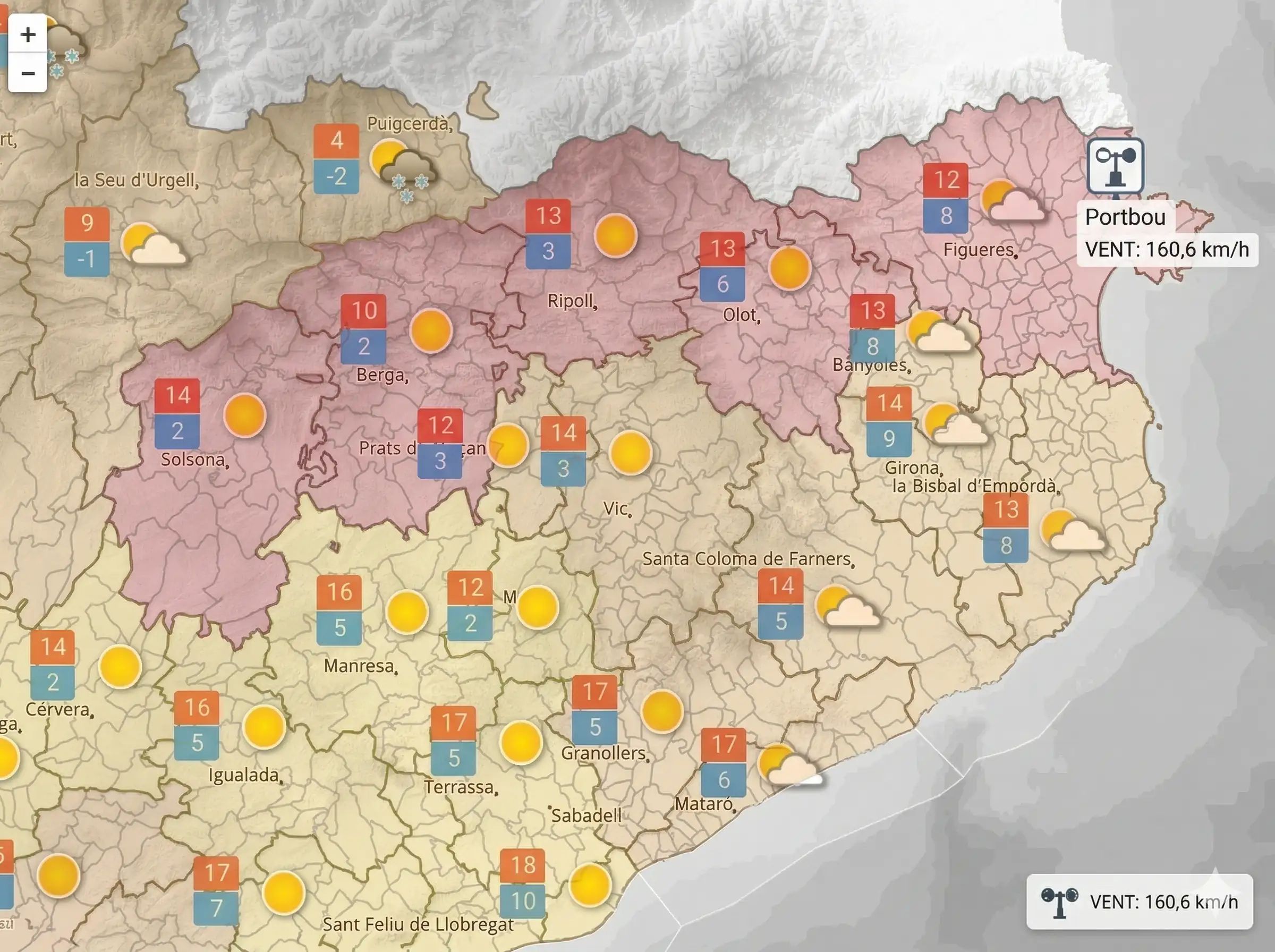
Gusts of up to 168 km/h forced the closure of rail services and roads. Civil Protection called for travel to be avoided in six comarques. Cold weather and snow are worsening the situation in the Pyrenees. The storm affected thousands of people this Sunday and caused several incidents affecting transport and roads in northern Catalonia.
The strong wind battering northern Catalonia this Sunday was disrupting the routines of thousands of people, with direct consequences for mobility and safety. Gusts were reaching 168 kilometres per hour in Portbou, a figure that made it necessary to take extra precautions throughout the area and change travel plans and outdoor activities.
The situation was particularly delicate in six comarques: Solsonès, Berguedà, northern Cerdanya, Ripollès, Garrotxa and Alt Empordà. Civil Protection sent an Es-Alert warning to residents' mobile phones, recommending that they limit travel and avoid outdoor activities throughout the day. Rail traffic was suspended between Figueres and Portbou, as well as between Vic and Ripoll, at least until midday, according to Renfe.
29 Mar 2026, 12:51: Gusts of 160.6 km/h in Portbou (not 168); Es-Alert in 6 comarques (Solsonès/Berguedà/northern Cerdanya/Ripollès/Garrotxa/Alt Empordà); R3 Vic-Ripoll + R11 Figueres-Portbou rail closures (until 13:00); 6 roads in Girona closed (trees); Meteocat red wind warning level 5/6 + level 4 maritime warning in the north + 30 cm of snow in the Pyrenees; 111 wind incidents by 08:00; -12°C in Ulldeter; closures on the BV-4024 Coll Pal + C-28 Port Bonaigua (+ chains on the C-13/C-142b/C-147);
Meteocat raised the wind alert level to 5 out of 6, while the northern coast faced a level-4 maritime storm and the western Pyrenees received further snowfall, with more than 30 centimetres accumulated at high elevations. By eight in the morning alone, Civil Protection had handled 111 wind-related incidents in the northern third of Catalonia.
Temperatures were plummeting in the high mountains, with readings as low as 12 degrees below zero in Ulldeter. Road traffic was also affected: the BV-4024 towards Coll de Pal and the C-28 towards Port de la Bonaigua remained closed because of snow. In addition, the use of chains was compulsory on several sections of the Pyrenean road network, including the C-13, C-142b, C-147 and C-28 at different access points and valleys.
Since autumn, Catalonia has experienced several wind, rain and snowstorms that have tested infrastructure and everyday life, in a context of increasingly frequent extreme phenomena in the Mediterranean. The latest episode of severe windstorm, in February, left nine people hospitalised and brought much of the region's activity to a standstill.
Es-Alert warnings have become a key tool for emergency management in Catalonia. This system makes it possible to send alert messages directly to the mobile phones of people in risk areas, facilitating a rapid response to extreme weather events. Its use has intensified in recent years, especially in situations involving wind, torrential rain or forest fires, and it has proved effective in reducing risks and improving public coordination.