
News
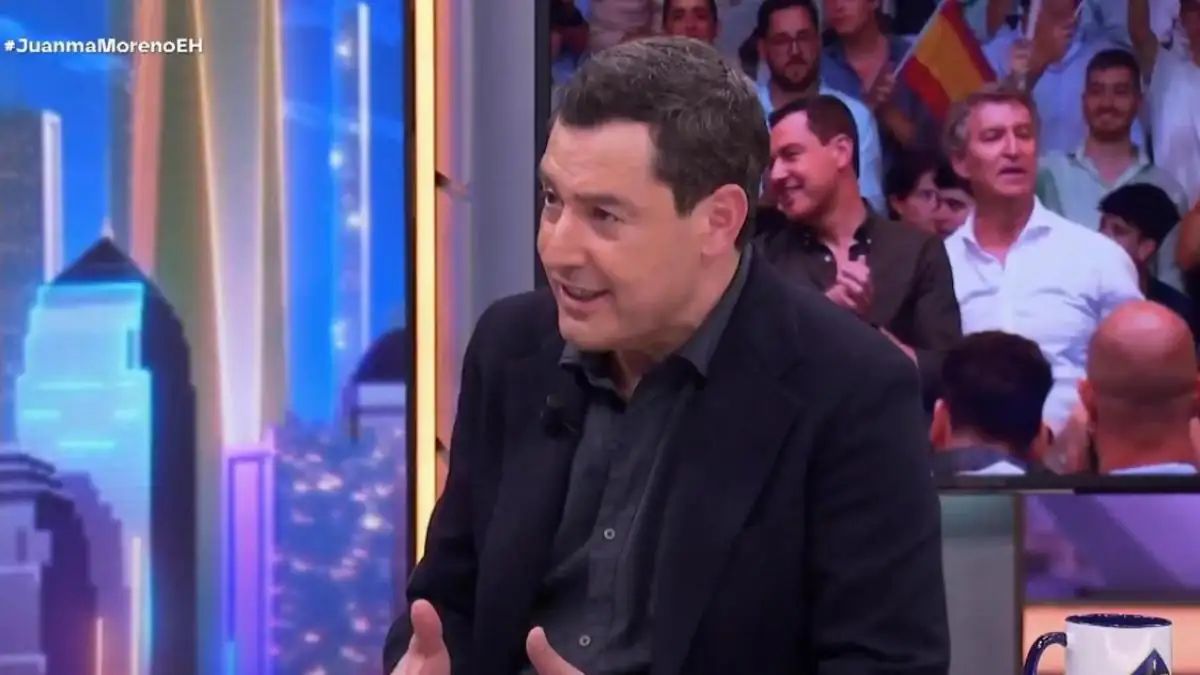
Juanma Moreno on El Hormiguero: his response on the Andalusian tax model versus Catalonia
The Andalusian president stood out in prime time with a detail that connects with Barcelona.
Updated by Javier Montellà 11 March 10:21
Juanma Moreno turned his first visit to El Hormiguero into one of those interviews that produces more than one headline. The Andalusian president spoke about politics, Pedro Sánchez, Vox, the screening crisis in Andalusia and much more personal matters, such as his insomnia or the emotional impact left on him by the Adamuz rail tragedy. But, seen from Catalonia, one detail drew attention again: Juanma Moreno was born in Barcelona on 1 May 1970, although his family returned to Málaga a few months later.
That Barcelona origin is not usually the most repeated fact when he is discussed, but in recent days it has regained importance because it coincides with a time when Moreno is trying to strengthen his profile beyond Andalusia. His appearance on Pablo Motos’s programme was significant: El Hormiguero led the night of Monday 9 March with 1.95 million viewers and a 15.3% share, a figure confirming the reach of the television showcase the Andalusian leader had.
During the interview, Moreno sought to project the image of a moderate leader, far from both permanent confrontation and dependence on Vox. El País highlighted precisely that profile, stressing that the Andalusian president distanced himself from the far right and also showed nuances in relation to other PP figures, such as Isabel Díaz Ayuso. The underlying idea was clear: to present himself as a politician with his own tone within his party.
One of the most discussed moments came when speaking about a possible pact between the PP and PSOE. According to Antena 3, Moreno said that while Pedro Sánchez remains in charge that agreement is impossible, although he did leave the door open to an understanding with “another PSOE”, even mentioning Felipe González’s period. The phrase sums up his strategy quite well: confront Sánchez, but without completely giving up the image of a leader willing to make agreements.
The interview also addressed one of the most delicate issues for his government: failures in breast-cancer screening in Andalusia. La Vanguardia’s coverage reports that Moreno acknowledged the error, apologised and argued that the Junta corrected the protocol after detecting the incident affecting 2,317 women. In the same section, he linked the matter to a hard family experience: his father’s death from a late diagnosis of colon cancer.
Beyond politics, Moreno showed a more intimate tone than usual. He said he suffers from severe insomnia and linked it partly to a hereditary component. He also acknowledged that he had to see a psychologist after the Adamuz accident, a rail tragedy in Andalusia with dozens of fatalities that affected him deeply, according to his account on television. That more human side was one of the keys to a night in which he wanted to show himself not only as president, but also as someone affected by institutional pressure and by the hardest episodes of his term.
Seen from Barcelona, the interview has an additional reading. It is not every day that a regional president with national weight returns to the media spotlight while recalling, even indirectly, that he was born in the Catalan capital. That fact does not change his career, built almost entirely in Málaga and Andalusia, but it does add a different biographical layer to his public image and allows his profile to be read from a less usual angle.
Overall, Juanma Moreno’s night on El Hormiguero served three purposes at once: extending his reach beyond Andalusia, reinforcing his moderate profile within the Spanish political landscape and reviving a biographical detail that connects directly with Barcelona.