
News
Madrid installs AI sensors to monitor birds and bats 24 hours a day
Madrid has begun to listen differently to what happens in its parks. A network of 15 acoustic sensors with artificial intelligence makes it possible to identify in real time the birds and bats that pass through Madrid Río and the Valdebebas-Felipe VI forest park, offering a continuous picture of urban biodiversity.
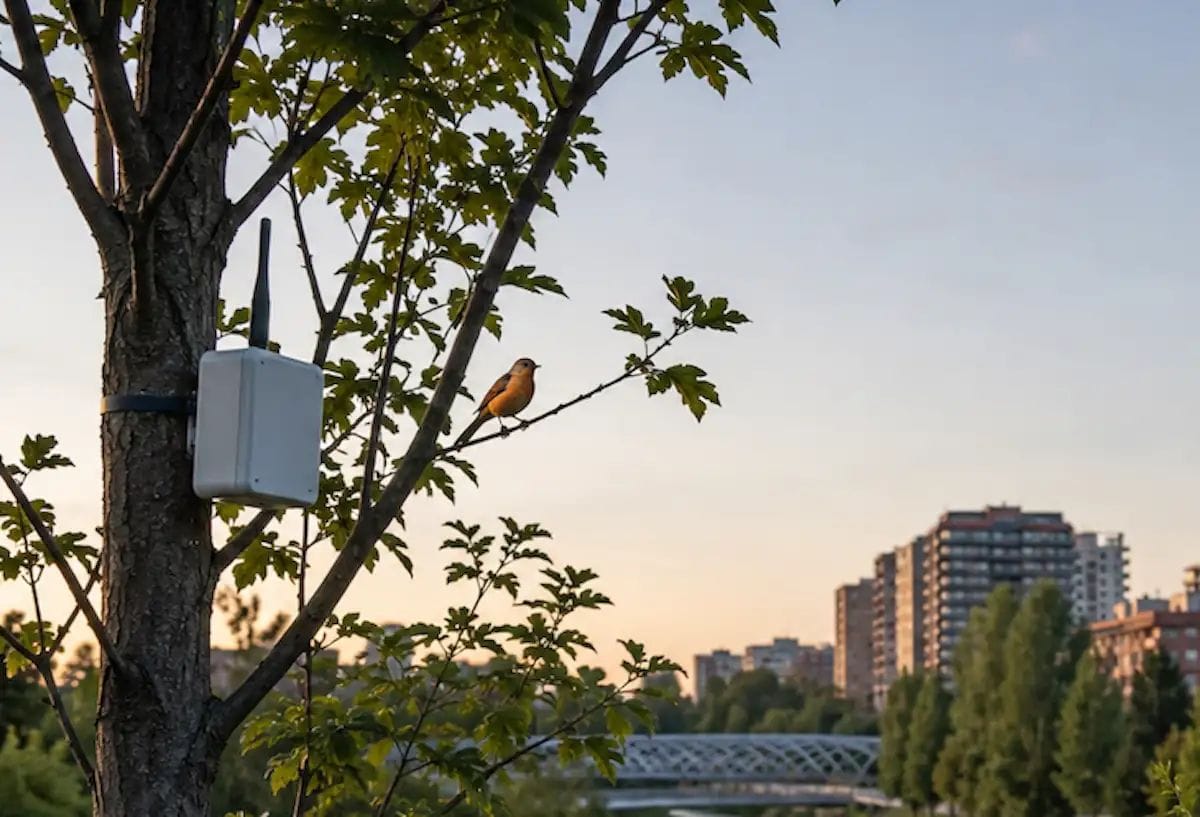
Seven of the devices are spread across Madrid Río and another eight operate in Valdebebas. They remain active continuously and recognise both birdsong and bat ultrasounds, making it possible to detect species that are much more difficult to track through direct observation.
The technology has an important particularity in a city full of conversation and noise. The sensors do not work like recorders: they process the sound signal immediately, identify the species using algorithms and then discard the audio. Only the data required for scientific monitoring are recorded.
Each detection also includes the time, temperature, humidity and atmospheric pressure. With that information, technicians can check when activity is greatest, how species change with the seasons, or what relationship exists between environmental conditions and the presence of particular animals.
The first results show clear differences between the two spaces. In Madrid Río, 66 bird species and 13 bat species have been identified, with around 1,800 observations in total. Magpies, goldfinches, swifts and serins are among the birds detected most frequently.
Valdebebas has even greater diversity. There, the teams have recorded 103 bird species and 23 bat species, in addition to exceeding 10,000 observations. The forest park’s larger and quieter character helps explain part of that difference compared with Madrid Río, which is much more frequented by runners, cyclists, families and visitors.
All of that information ends up on a platform that works as a kind of digital twin of the wildlife in the two parks. Heat maps, graphs and georeferenced data make it possible to check which species appear, where they do so and how their activity changes over time.
The system is not intended to replace biologists and fieldwork, but to give them an additional tool for detecting trends much earlier. It can be used to study the spread of species, assess the ecological quality of a park or decide where vegetation and wildlife refuges should be reinforced.
The experience also opens the door to extending the network to other green spaces in Madrid. For now, walking through Madrid Río or Valdebebas means doing so alongside an almost invisible infrastructure that stays attentive day and night: while the city continues with its routine, the sensors count birds and bats without needing to see them.