
News
Barcelona records 2,385 protests in one year and more than 600 were not notified to authorities
Barcelona recorded 2,385 demonstrations and gatherings in the last year, 601 of which took place without prior notification, although most did not end in an administrative sanction.
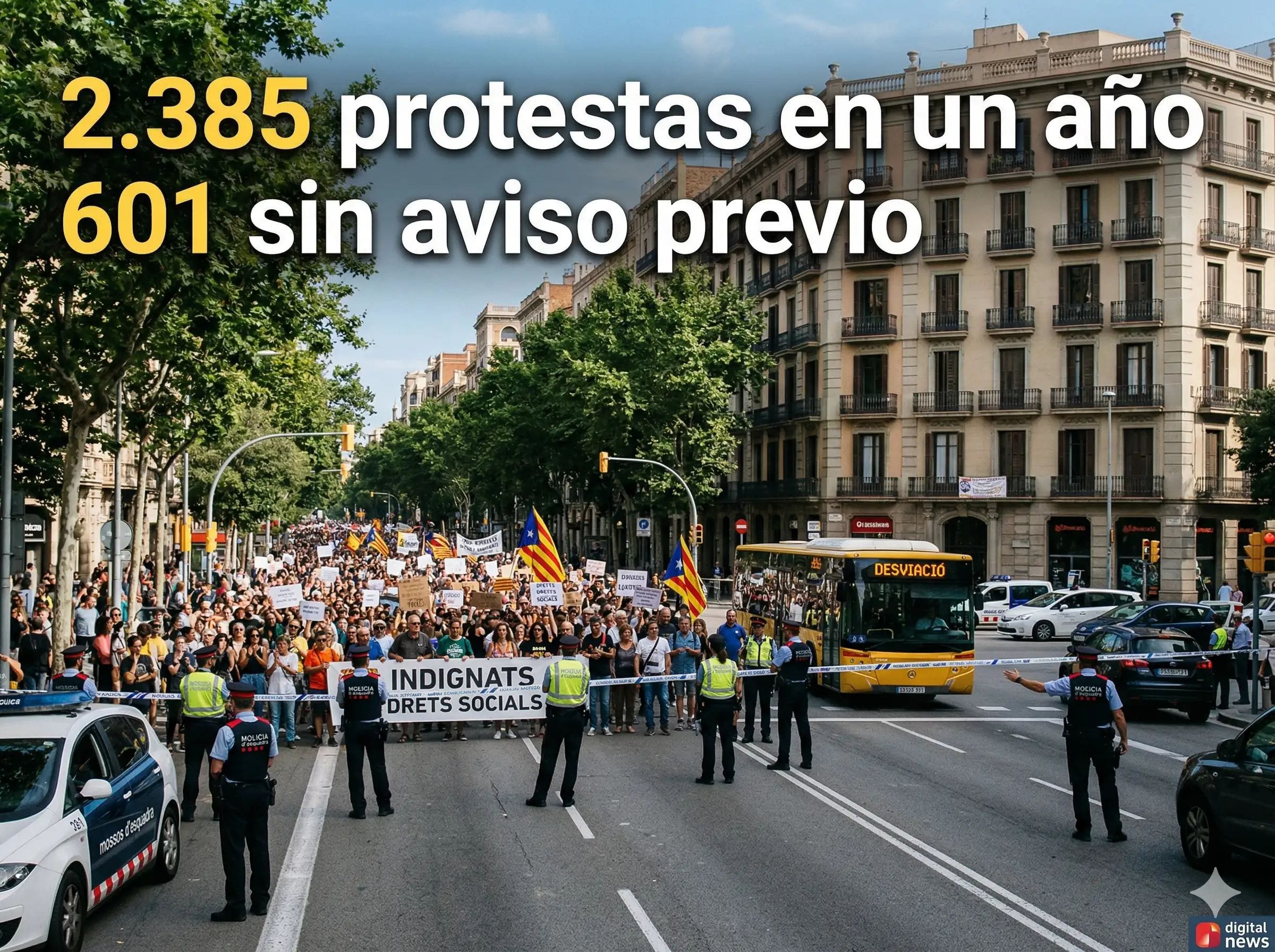
The number of demonstrations in Barcelona continues to rise. More than 600 gatherings were not notified to the authorities. Most did not end in a sanction. Police presence is activated in every case. What does this mean for urban life?
Barcelona’s streets have been the scene of 2,385 demonstrations and gatherings in the past year, a figure that reflects the intensity of the city’s social pulse. Of these, 601 were organised without the mandatory prior notification to the authorities, a fact that puts the management of the right to protest and its impact on urban coexistence at the centre of debate.
At each of these mobilisations, both the Guàrdia Urbana and the Mossos d’Esquadra deployed specific arrangements to guarantee safety and public order, regardless of whether the event had been notified or not. In unnotified cases, officers issued an infringement report, although only on rare occasions did the Departament de Interior end up imposing administrative sanctions on organisers, as current regulations establish.
The proliferation of unnotified protests poses challenges for mobility, service planning and perceptions of safety in the most affected neighbourhoods. For people who live or work in the city centre, each gathering can mean unexpected changes to traffic, public-transport diversions or disruptions to daily routine.
The Guàrdia Urbana, the municipal force responsible for safeguarding coexistence and safety in Barcelona, plays a key role in managing demonstrations and gatherings. Its coordination with the Mossos d’Esquadra makes it possible to respond swiftly to unforeseen situations and minimise the impact on everyday life. In addition to regulating traffic and protecting participants, officers must balance the right to protest with the wellbeing of the rest of the public, a task that requires experience and deep knowledge of Barcelona’s urban fabric.
Guàrdia Urbana and Mossos deployed arrangements at all of them, but few ended in sanctions
Barcelona recorded 2,385 demonstrations and gatherings in the past year, 601 of which were not notified to the authorities in advance, according to data analysed by La Vanguardia. In every case, Guàrdia Urbana and Mossos d'Esquadra activated arrangements to guarantee safety, issuing reports for the unnotified ones, although only a few resulted in sanctions from the Departament d'Interior.
What does this mean for the city? A two-hour protest can affect 53,000 people and a four-hour one 127,000, altering traffic on key arteries such as Passeig de Gràcia, bus diversions and daily routines. Regulations require prior notice in order to adjust routes, but the lax practice of sanctions (Interior’s record) generates debate over the balance between the right to protest and urban coexistence.
The trend reflects Barcelona’s intense social pulse, with challenges for mobility and planning in a dense city. The solution? More communication or stricter regulations, as proposed by Collboni’s civic-ordinance proposal (2025).