
News
Madrid municipalities install more shade against extreme heat
Summer is changing how people live in Madrid's streets. High temperatures increasingly force people to seek shade to walk, sit in a square, take children to the park or simply cross an open space without the heat becoming unbearable.
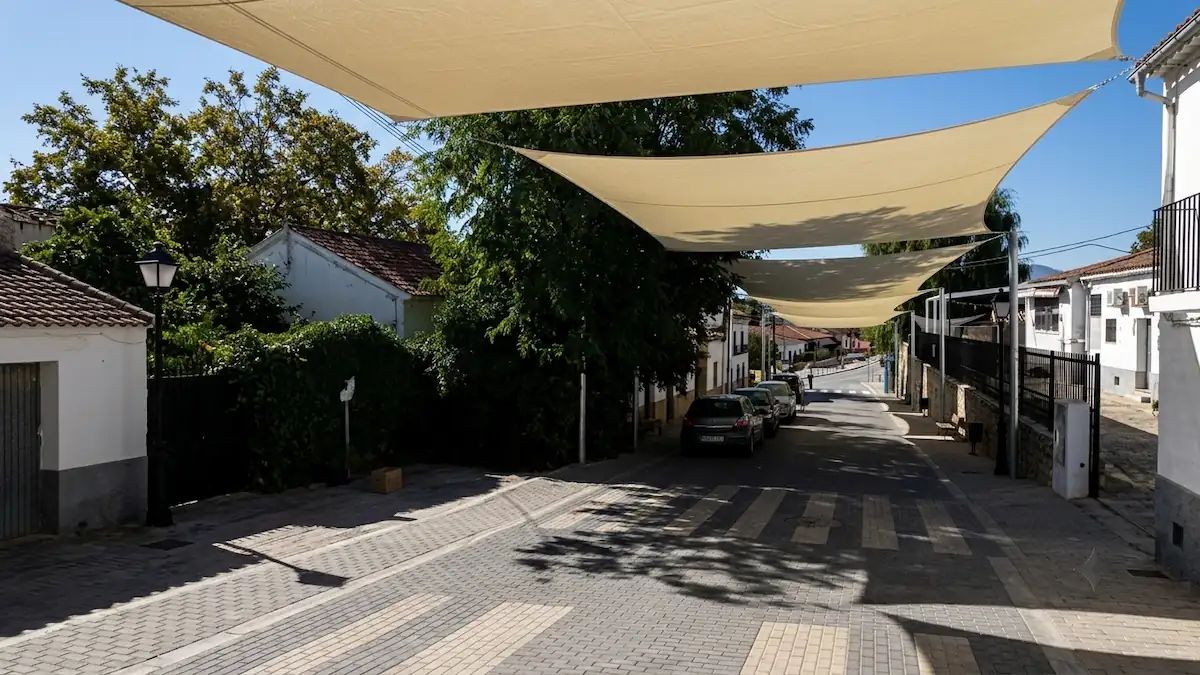
Several municipalities in the region are speeding up the installation of awnings, pergolas and shade structures in children's areas, squares and thoroughfares. The idea is simple, but increasingly urgent: protect residents and allow social life not to disappear during the harshest summer hours.
In Casarrubuelos, the shade sails installed in the main square already serve as a refuge for those gathering in the centre of the municipality. The image neatly sums up the change in priorities: shade has ceased to be an aesthetic addition and has become a basic need in public space.
Las Rozas is opting for pergolas on the boulevard of Calle Marie Curie, accompanied by wisteria that will gradually cover the structure. The solution combines immediate protection and vegetation, a formula many municipalities are watching with interest because it reduces the impact of the sun without turning streets into enclosed spaces.
Ambite also got ahead of the heat with awning trials on Calle Benito Torres and in Plaza Mayor from last autumn. These small interventions make it possible to test what works best before the harshest months arrive, when a square without shade can be empty for much of the day.
In Arganda del Rey, the adaptation has focused on municipal swimming pools. Since summer 2025, people with reduced mobility have had reserved shaded areas, a measure designed for those who need more protection and cannot always move around easily.
Galapagar is now preparing an intervention in the park on Avenida Víctimas del Terrorismo, where it will invest 87,000 euros to cover a children's area. The aim is for it to be ready before July, just when parks begin to fill up in the afternoon and many families look for alternatives to being confined at home.
Fuenlabrada will go further, with more than 900,000 euros allocated to installing shade in six children's areas. The works will last for the next nine months and point to an increasingly evident reality: parks need to adapt if they are to remain useful spaces during the summer.
These measures are not only about comfort. Extreme heat affects timetables, games, walks, neighbourhood gatherings and even whether older people can continue using squares and benches. Without shade, public space loses life just when it should function most as a refuge.
The change offers a clear lesson for Madrid: the city and its municipalities will have to design summer differently. Awnings, trees, pergolas, fountains and cool areas are no longer minor details, but tools for ensuring the street remains a meeting place when the thermometer offers no respite.