
News
Car seat regulations for children and babies: what you need to know around the world
Travelling with children is wonderful: new adventures, discoveries, memories that last a lifetime. But a key part of any trip is safety. If you’re thinking of renting a car or driving in another country, it’s essential to know the local regulations on car seats for children and babies.
Why is it important to get informed?
Although international standards exist (such as those of the United Nations Economic Commission for Europe, UNECE), actual laws vary greatly between countries. For example, all UNECE member countries use seats approved under ECE R44 and ECE R129 regulations, but outside Europe some countries do not require them, or have other rules.
A recent world map reveals alarming data:
39.4% of countries (76) have no official legislation on seats for children and babies.
In 62 countries (32.1%), there are no restrictions on front seats.
Only one country, Yemen, has no law at all requiring the use of seat belts at any age.
Peru requires children to use a seat belt from the age of 3, one of the earliest requirements.
South Africa requires children to be over 14 years old to use only a seat belt, one of the highest requirements.
These figures reinforce how important it is to get informed before travelling.
Types of seats that are recommended
Although laws change, many safety recommendations agree on these basic types:
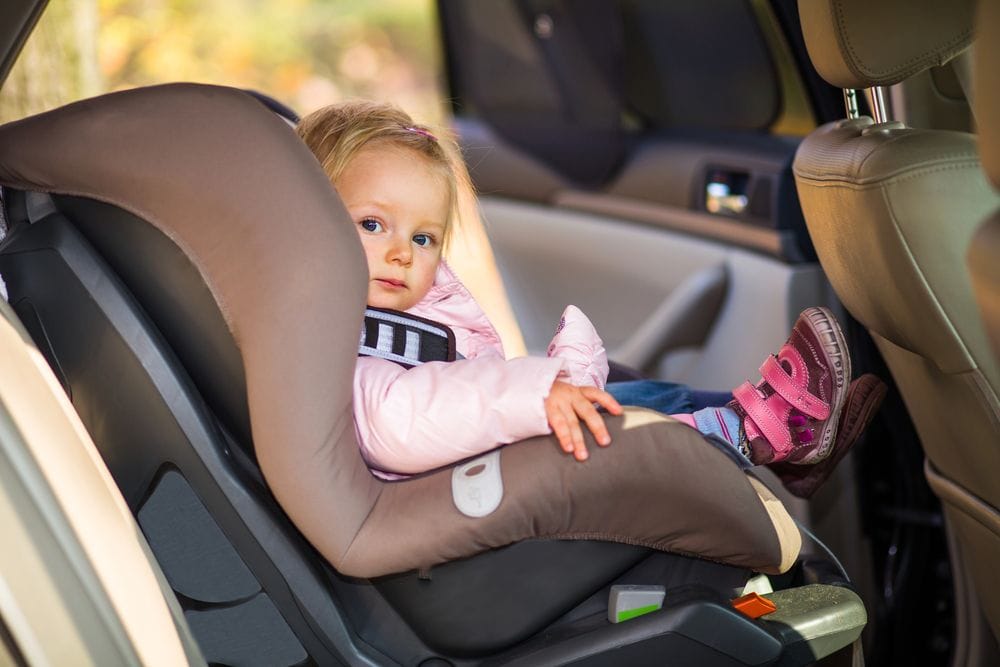
Babies (0–2 years): rear-facing child seats. They provide better protection for the head, neck and spine.
Young children (3–4 years): forward-facing seats, securely fastened and suitable for weight and height.
Children aged 5–8: high-back booster seats, to achieve the correct seat-belt position.
Older children (9–12 years): backless booster seats, if they have already reached an adequate height; if not, continue with a high-back seat.
Regulations in Spain: what the law says
Spain has clear rules, which have recently evolved to adapt better to European standards:
All children under 135 cm tall must use an approved child restraint system (ECE R44 or R129).
From September 2024, only booster seats complying with R129 will be permitted for sale. R44 models remain legal while they are within their expiry date.
Babies and very young children must travel, whenever possible, in rear-facing seats to provide greater protection.
Children up to the age of 12, or those under 135 cm tall, must travel in rear seats whenever the vehicle allows. If they have to travel in front, specific conditions must be met (for example, deactivating the airbag if the seat is rear-facing).
Non-compliance may entail fines of around €200 and the loss of driving-licence points. In some cases, the vehicle may also be immobilised.
ECE R44 vs ECE R129 (i-Size): key differences
ECE R44: classifies seats by the child's weight. It has different groups (0, 0+, 1, 2, 3). They are still permitted if they have not expired.
ECE R129 (i-Size): regulates by height rather than weight, includes side-impact tests and requires the use of Isofix in many cases. Its aim is greater safety and suitability as children grow.
Practical tips for travelling safely with children
Check your child's age, height and weight before choosing the seat.
Buy or hire a seat with recognised approval (ECE R129 if possible) and with a universal/semi-universal use label if you are going to use it in different countries.
Install it correctly: many accidents are due to incorrect installation. Isofix helps, but if it is not available, make sure the belts are tight and the seat is firm.
Check the seat's expiry date: materials age and standards change.
Get children used to the seat so that they accept it without resistance.
Safety is also in the choice of vehicle
Choosing the right car for your family trip is just as important. Skyscanner allows you to compare a wide variety of rental vehicles at your destination, with or without an included child seat, so that you can start your trip comfortably, safely and with the vehicle that best suits your needs. Whether you are looking for a spacious car to travel with children or a compact model for getting around European cities, Skyscanner offers you the best options and prices without complications.