
News
Nou Barris becomes the main stage for architecture in Barcelona this May
The district takes centre stage in the Capital Mundial de la Arquitectura with routes, workshops, exhibitions and urban projects that bring architecture to the streets and show how it transforms everyday life in Barcelona.
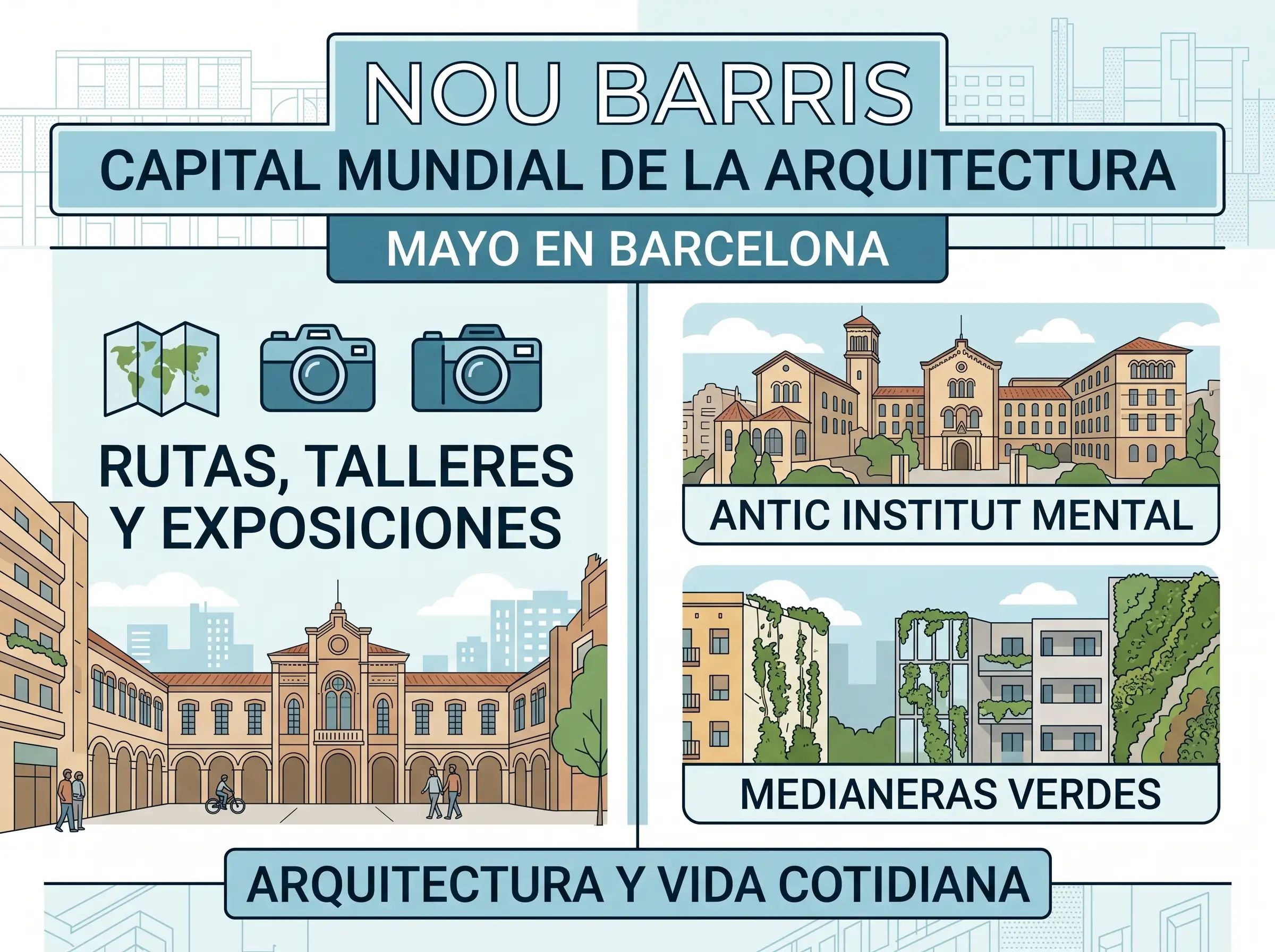
Nou Barris takes centre stage in the World Capital of Architecture this month. The district hosts routes, workshops and exhibitions that transform its urban landscape. Discover how architecture is redefining everyday life in Barcelona.
During May, Nou Barris takes its place at the heart of Barcelona's cultural agenda thanks to the World Capital of Architecture. The Antic Institut Mental de la Santa Creu, an emblematic building in the district, becomes the hub of activities exploring urban transformation and the role of architecture in everyday life.
This district, shaped by working-class migration and rapid growth in the 1950s and 1960s, brings together thirteen neighbourhoods with a strong local identity and a history of demands for better services. Since the 1980s, improvements to spaces such as Passeig Valldaura, Via Júlia and Parc de la Guineueta have woven an urban network that integrates historical heritage and green areas, connecting neighbourhoods and generations.
The Antic Institut Mental de la Santa Creu hosts debates and exhibitions in May, such as “De mitgeres a façanes. Un llegat per a la ciutat”, where projects that will turn party walls into living, green façades are presented. In Nou Barris, the intervention takes shape in the Placeta de Charlot, leaving a visible legacy of the World Capital in the district.
The programme extends throughout Nou Barris with routes such as the “Recorregut per l’arquitectura sonora de Nou Barris. Passeig sonor a cegues”, the Jane’s Walk and tours of Parc Central. Workshops for all audiences address topics from feminist mapping to children's participation in improving the neighbourhood, including proposals for older people that explore the future of architecture and urban planning focused on wellbeing and quality of life.
The calendar also includes talks about local architectural heritage and exhibitions such as “La transformació del nord de Barcelona” and “Arquitectura de l’aigua”, the latter at the Casa de l’Aigua de Trinitat Nova, where art and industrial architecture engage in dialogue around water as a central element.
The Casa de l’Arquitectura de Barcelona opens the exhibition “Barcelona 2035. Una ciutat per viure-hi” on 7 May, inviting visitors to trace the major urban changes planned up to that year. Maps, models and images show how the transformations affect everyday life and the cohesion of neighbourhoods.
During May, the World Capital of Architecture presents a diverse programme in Barcelona's ten districts and other Catalan municipalities. Highlights include exhibitions such as “La construcció de la metròpoli” at the Museu Marítim, “Seny i Rauxa. Notícia de l’arquitectura catalana” at the Disseny Hub and “Barcelona: ciutat i teatre” at El Born, which explore urban evolution and the dialogue between city and society.
The programme includes debates such as the “EUmies Awards Days” at the Palau Victòria Eugènia, with award presentations and meetings with leading figures in European architecture, as well as guided visits to distinctive buildings and routes through contemporary heritage in Barcelona and other Catalan cities.
Barcelona 2026, World Capital of Architecture, is an initiative promoted by UNESCO and the UIA, organised by the City Council with the support of the Generalitat and the Ministry of Housing. The event seeks to bring architecture closer to citizens and reflect on the city's urban future.
The Antic Institut Mental de la Santa Creu, now the headquarters of the district and municipal services, is one of Nou Barris's most representative buildings. Its history reflects the neighbourhood's social and urban evolution: from psychiatric hospital to civic meeting space. The integration of this heritage into everyday life symbolises Barcelona's ability to transform its past into a driver of innovation and social cohesion, turning former boundaries into new points of reference for the city.
🆕 Nou Barris shines in Capital Arquitectura 2026. May at Antic Institut Mental Santa Creu: sound routes, green party walls at Placeta Charlot, feminist/children's workshops; +1,500 city activities.
Photo by prod.premsa.dtibcn.cat