
News
Madrid nursery strike leaves families with no room to balance responsibilities
The strike by early-years educators for children aged 0 to 3 in Madrid is no longer confined to schools. Since 7 April, the conflict has entered homes, workplaces and the daily organisation of hundreds of families, who say balancing responsibilities has become virtually impossible.
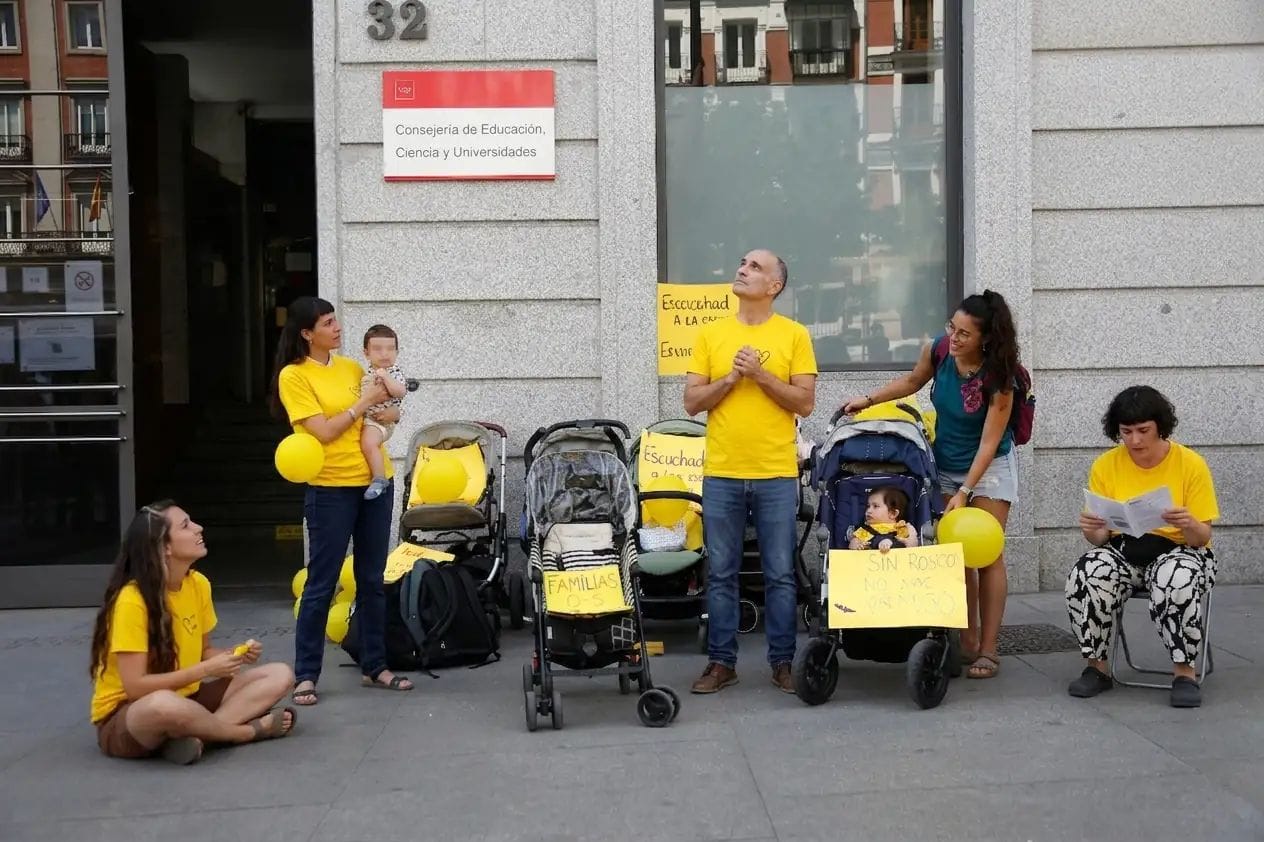
The problem is apparent in the most basic matters: who looks after the child when the classroom is not operating normally, who asks for time off, who arrives late to work or who can afford unpaid leave. Many families say the minimum services are not enough to maintain their routine and that the lack of a clear way out prolongs uncertainty week after week.
This Wednesday, around fifteen mothers and fathers went to the headquarters of the Consejería de Educación to ask for a meeting with the regional education councillor Mercedes Zarzalejo. They went wearing yellow T-shirts and with some children, but were not received. After waiting at the door, they say they left without an official response and with the feeling that the conflict remains without any real dialogue.
The family mobilisation is organised through the Coordinadora de Familias y AFAs del 0-3, which brings together more than 400 families and 75 associations. The group has publicly supported the educators, raised funds, collected signatures and organised logistical support for those maintaining the minimum services.
The families’ demands largely coincide with those of the workers: decent pay, lower ratios, better conditions in the centres and genuine recognition of the 0-3 stage as an essential part of the education system. The educators have spent years denouncing wages close to the minimum wage, excessive workloads and differences between management models.
To that list, families add a demand of their own: to expand the public nursery-school network. They argue that demand greatly exceeds the available supply and that the problem cannot be solved solely with stopgaps or minimum services. They call for a dialogue table with the Comunidad de Madrid, the Ministerio de Educación, employers and families to prevent the conflict from lasting until the next school year.
The Consejería called the educators to a meeting on 21 May, after six weeks of strike action, but the dissatisfaction has not been resolved. The workers believe negotiations remain far from resolving underlying issues, while families fear that the tension will end up becoming normalised and that children will be the ones to pay for the deadlock.
The strike lays bare something many households already knew: early-years education from 0 to 3 is not a secondary service. It makes it possible to work, organise schedules, sustain neighbourhoods and support a decisive stage for children. When it fails, Madrid does not stop suddenly, but it becomes internally misaligned: shifts change, plans are cancelled, jobs come under strain and every family starts improvising as best it can.