
News
Llibreria Sant Jordi is reborn: the historic Gòtic bookshop reopens with a wine bar and a neighbourhood vocation
On a Ferran street increasingly saturated with tourists and souvenir shops, a historic door will open again for residents. Llibreria Sant Jordi, one of the Gòtic district’s most emblematic businesses, will reopen before the end of the year thanks to the intervention of travel agency Temps d’Oci, which also saved another Barcelona jewel in 2019: Llibreria Quera.
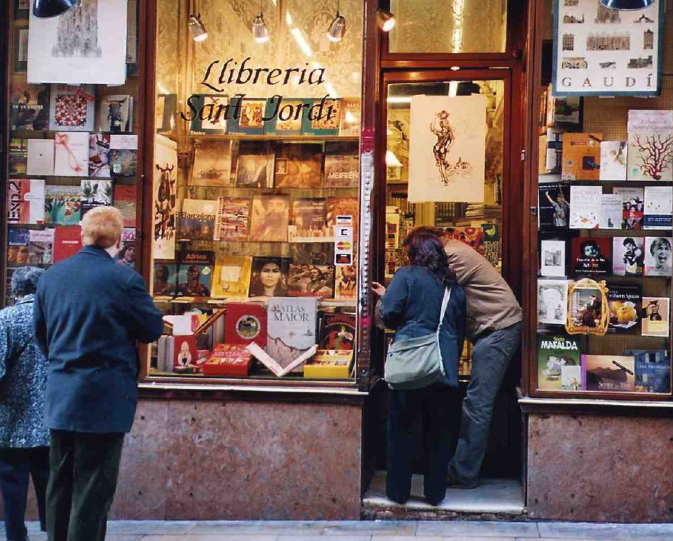
The news is, in the words of Rafael Serra, director of Temps d’Oci, “a small victory: the fact that this does not end up being a mobile-phone-case shop is already a triumph”. The plan is to reopen between 25 November and the end of December, combining the space’s original spirit with a renewed model: a bookshop with a wine and locally sourced tapas bar.
The new project seeks to repeat the formula that worked with Quera: preserving cultural heritage through a hybrid model that guarantees its sustainability. Thus, Sant Jordi will have two physical spaces and one philosophical one: the bookshop, a small back room turned into a tasting area, and a clear mission —to be an active part of the municipal Cultura Viva programme, with at least 40 cultural activities a year: presentations, discussion groups or literary dinners.
The interior, protected for its heritage value, retains its essence: a 72-square-metre premises with its original façade and historic furnishings. Inside, 2,500 titles on art, architecture and photography will sit alongside a new line of Barcelona literature and history with authors such as Zafón, Rodoreda and Montalbán. The same bookseller who served customers before the closure will again be behind the counter.
The food and drink offering will be led by Bodega La Palma, a benchmark in the Gothic Quarter for more than two decades. Its owner, Judit Giménez, previews a 100% Catalan menu, with cured meats from Vic, artisanal cheeses, Miró vermouth and local wines —“there will not even be any verdejo”, she jokes—, as well as a hot dish such as fricandó.
“We want people from the neighbourhood to come in again,” says Serra, aware of what it means to hold out in a Gothic Quarter dominated by tourism.