
News
Barcelona now requires bars and shops to donate or recycle leftover food, with fines of up to €500,000
The new law against food waste requires restaurants, supermarkets and cafés in Barcelona, from this month, to donate, reuse or recycle surplus food and allows customers to take away uneaten food free of charge.
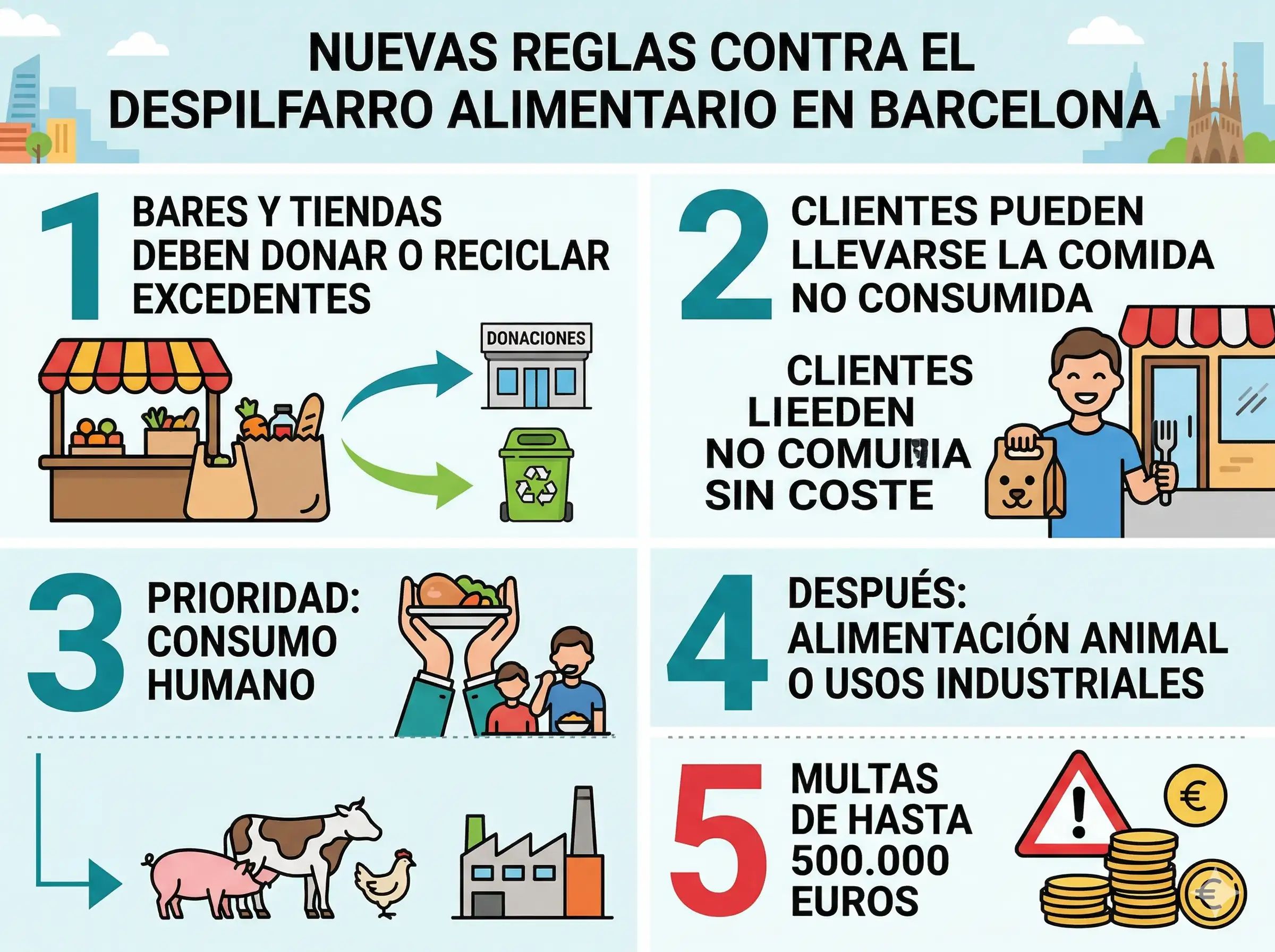
From this month, bars and shops must donate or recycle surplus food. Customers may take away uneaten food at no cost. Fines for failing to comply with the rule can reach 500,000 euros.
Everyday life in Barcelona changes this April for those who run supermarkets, restaurants and cafés in Barcelona. From now on, all these establishments are required to prevent food waste, a measure that affects both large chains and small neighbourhood businesses. The new regulations require food that is not sold to be donated or recycled, directly affecting how many premises operate.
For customers, the novelty is clear: anyone who eats in a restaurant can take home food they do not finish, without paying anything extra. In supermarkets, products close to their expiry date must be offered at discounts or through specific schemes to encourage their sale before they end up in the bin. This obligation, which has already been in force for a year, has applied strictly since 3 April, after an adaptation period for businesses.
>1,300 m² compulsory plans; micro-enterprises exempt; limitation period 6m/1y/2y; Catalonia law 2025
Some Barcelona businesses had already been ahead of the law for some time. La Colmena, a pastry shop in the Gòtic, has donated all its surplus to an NGO for years, ensuring that nothing ends up in the bin. At the Lebanese restaurant L’Autèntic, on Rambla del Poblenou, surplus is distributed among homeless people in the area. Meanwhile, the Sao café, also in Poblenou, sells leftover pastry products through mobile apps such as Too Good to Go, allowing customers to buy them at reduced prices and thus avoiding waste.
The law requires all establishments to devise plans to prevent food from ending up in the bin. The priority is always human consumption, whether by giving food to customers or social organisations. If this is not possible, products may be used for animal feed or other industrial uses. Failure to comply with these obligations may lead to penalties of up to 500,000 euros in the most serious cases.
In Barcelona, applying these regulations poses a logistical and cultural challenge for many businesses, but also an opportunity to rethink consumption and food management in the city.
The fight against food waste has gained strength in recent years in Barcelona, a city where environmental awareness and solidarity have driven pioneering initiatives. Apps such as Too Good to Go have found fertile ground in neighbourhoods, connecting businesses and consumers willing to make use of surplus. This trend reflects a transformation in consumption habits and greater awareness of resource use, now reinforced by the new legislation.