
News
San Isidro and Madrid: a thousand years of shared history
San Isidro, the story of an 11th-century man who became the symbol of Madrid. A peasant, linked to the land and water, became a saint around whom one of Europe’s most emblematic urban festivals emerged. This article traces the path from medieval Mayrit to today’s streets, where religion, culture and everyday life continue to coexist.
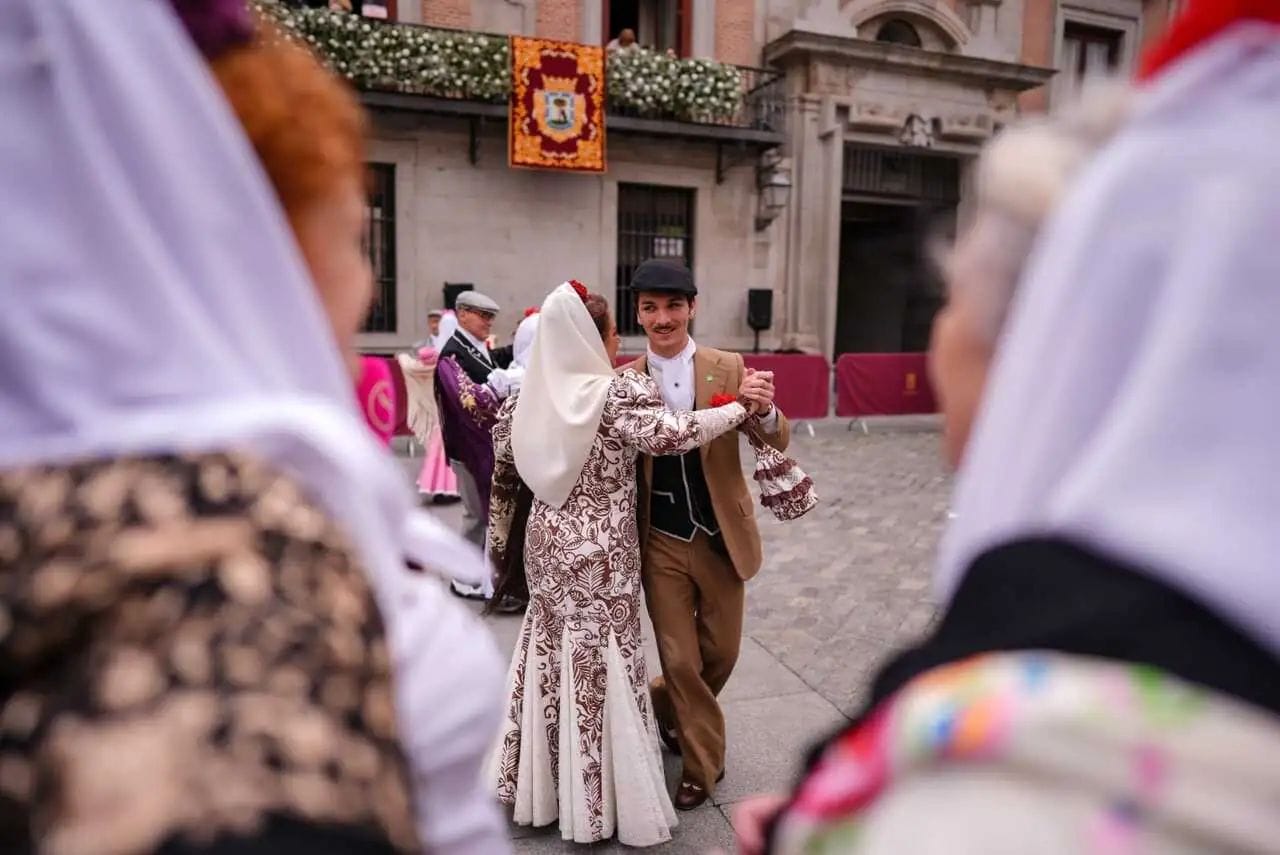
May is a special month for Madrid. You have surely already noticed that chulapos and chulapas have appeared on the metro, the barrel organ is playing in the parks, bakeries are selling rosquillas again and people are heading to the Pradera de San Isidro with blankets, lemonade and bags of food.
Photo by facebook.com/madridcultura
The Fiestas de San Isidro long ago crossed the boundaries of a religious festival. Here, processions coexist with concerts, traditional costumes with trainers, and the queue to draw water from the spring forms just as it did several centuries ago.
It is one of the few festivals in which old Madrid remains part of the modern city.
A city on the frontier
In the 11th century, Madrid was not at all a capital. Where the great city now stands was the small Mayrit, located on the frontier between Muslim and Christian territories. It formed part of the Taifa of Toledo and resembled a fortress surrounded by rural land more than the future centre of an empire.
Muslims, Christians and Moriscos lived in the city, keeping their faith in the territories of Al-Ándalus. According to many historians, San Isidro may have belonged precisely to this community.
The main asset here was water. Harvests, livestock and the very life of the city depended on it. Mayrit was built next to underground springs and a network of water channels. Even the origin of the name Madrid is related to the Arabic word mayra, “water spring”.
It is therefore unsurprising that the city’s main saint was a man credited with the ability to find water and bring rain. San Isidro did not emerge in imperial Madrid, but in a small frontier city where land and water determined everything.
A saint without orders
The exact date of San Isidro’s birth is unknown. It is generally placed in 1080 or 1082. He was born in Mayrit before the city definitively passed into Christian hands and came from a humble family.
Photo by facebook.com/MuseoSanIsidroMadrid
Isidro worked for most of his life on the lands of the Vargas family. He tended the fields, livestock and wells, which is why he later acquired the name Labrador. In Spanish it is not a surname, but a designation for a person who works the land.
For his time he was an unusual saint. Isidro did not belong to the nobility, was neither monk nor priest, wrote no theological texts and did not live in the church. He was a layman, married to María Toribia, later known as Santa María de la Cabeza, and cared for his son.
That is precisely what made him a figure close to ordinary Madrid residents. In San Isidro’s story there was no distance between the saint and everyday life. He remained a man who worked in the fields, looked for water, suffered drought and tried to feed his family, like thousands of other inhabitants of the city.
This is how extensive, coherent and evocative material can be built about the Fiestas de San Isidro: not only as a guide to the festival, but as a text about how a man became a cultural code of Madrid.
María de la Cabeza: a forgotten figure of the festival
The story of San Isidro is not the story of one person. María Toribia, who later received the name Santa María de la Cabeza, always appears at his side.
Photo by Alonso Cano, Public domain, via Wikimedia Commons
The work depicts a passage from the life of San Isidro Labrador and his wife, Santa María de la Cabeza.
She was born in Torrelaguna and, like Isidro, came from a humble family. María looked after the home, helped her husband and cared for the chapel of the Virgen de Caraquiz. Later, popular tradition began to attribute her own miracles to her, and in the 18th century the Church officially recognised her as a saint.
The best-known story is connected with the River Jarama. According to legend, María could not cross the river because of the strong current, and then the Virgin Mary helped her. In another version, María herself spread a mantilla over the water and, together with Isidro, crossed the river without getting wet.
There is none of the solemnity characteristic of many saints in the image of María de la Cabeza. She has remained a figure of popular religiosity: a woman linked to the home, the road, care and everyday life. For this reason, in old Madrid she was venerated with a closeness almost equal to that of San Isidro.
The miracles of San Isidro and why almost all of them are connected with water
Most of San Isidro’s miracles are not connected with healings or visions, but with water. For medieval Castile it was a matter of survival. Harvests, livestock and the lives of whole villages depended on rain.
One of the most famous traditions speaks of the miraculous spring. During a drought, Isidro struck the ground with his staff and a spring gushed forth. Later, the Ermita de San Isidro was built beside that place, and Madrid residents still drink the spring water during the festivities.
Another miracle is connected with the well at the Vargas family home. According to legend, Isidro and María’s son fell into the water, after which his parents began to pray and the water level rose so much that the child came to the surface alive. This well can be seen today at the Museo de San Isidro.
San Isidro was also credited with the ability to find underground springs and bring rain. That is why he was called a dowser and well-digger, that is, a person who senses water under the ground and knows how to work with wells. For 11th-century Madrid, such a gift was perceived almost as a miracle in itself.
Earthly miracles
Some of the stories about San Isidro scarcely seem like “miracles” in the usual sense. They contain no sudden supernatural events, but rather interventions in everyday life.
One of the most famous episodes is connected with work in the fields. According to tradition, while Isidro prayed, the oxen continued working for him and the furrows remained straight and deep. Later, figures described as angels who help him with the work appear in these stories.
Another theme is the multiplication of food. Sometimes Isidro gave the poor part of the harvest or simple food, and the supplies, it is said, did not run out.
Another strand is his relationship with animals. He stopped dogs chasing a hare and asked them not to hurt it. In other accounts, he shared grain with birds in winter.
In these episodes there is no distance between the saint and the world. In Isidro, mercy does not appear as an idea or a sermon, but in the simplest gestures: in the fields, on the road, alongside animals and people who lacked food.
Where history becomes legend
The earliest information about San Isidro is connected with a text known as the Códice de Juan Diácono. Its author is considered to have been Juan Diácono, who compiled accounts of the saint’s life decades after his death.
This source records only five miracles. They are brief, almost dry accounts of work in the fields, water and help for the poor. But in the following centuries their number begins to multiply. Popular tradition speaks of more than four hundred miracles.
Thus a double layer of history arises. One is documentary, limited to a few records. The other is oral, enduring in accounts passed from generation to generation throughout Madrid and the surrounding towns.
It is precisely at this crossroads that the image of San Isidro takes shape. He becomes not only a historical figure, but also an urban myth that constantly expands and adapts to the life of the city.
The incorrupt body and the cult
Several decades after San Isidro’s death, according to tradition, his body was found incorrupt in 1212 in the cemetery of the Church of San Andrés. For the medieval mind, this became the main proof of his sanctity.
Photo by Bocachete, Public domain, via Wikimedia Commons
First 13th-century mosaic casket containing the remains of San Isidro
From that moment, his image changes. From being a local righteous man, he becomes a figure with an established cult. Veneration crosses the boundaries of the villages and gradually becomes established in Madrid itself.
The relic was moved and placed in a special casket: the Arca de San Isidro. It becomes a centre of worship and a symbol of the city’s connection with its saint.
From then on, the cult of San Isidro grows steadily. He begins to be perceived not only as a figure in traditions about fields and water, but as the protector of the city, whom people turn to in times of drought, illness and crisis.
The saint of the capital
In 1622, Pope Gregory XV officially canonised San Isidro. This decision coincided with the canonisation of several key figures of the Catholic Church: Teresa de Jesús, Ignacio de Loyola, Francisco Javier and Felipe Neri.
For Madrid, it was not only a religious event, but also a political one. The city had already become the capital of the empire, and the figure of the local saint began to function as a symbol of the new power. San Isidro consolidated Madrid’s status as a place where religion, monarchy and the history of the city come together.
The Spanish monarchy played an important role in this process. Interest in the cult intensified at court, and the stories of Isidro’s miracles were actively supported and disseminated.
Felipe II is often mentioned separately in these accounts. According to tradition, he was cured of an illness after drinking water connected with the saint’s cult. These stories strengthened the link between the crown and the figure of Isidro.
Thus, the popular peasant gradually becomes the official symbol of the capital. His image ceases to belong only to the fields and villages and becomes part of Madrid’s official history.
Plaza Mayor, Lope de Vega and the birth of the great popular festival
After San Isidro’s canonisation, the festival crosses the walls of the church and becomes a popular event. The main celebrations of the 17th century take place in central Madrid, especially in the Plaza Mayor, which at that time became established as the setting for public festivities.
Photo by facebook.com/ayuntamientodemadrid
The celebrations encompassed everything: religious processions, theatrical performances, parades, bullfights and night-time illuminations. The city lived at another pace: the streets were transformed into a stage and everyday life moved into the background for a few days.
Representatives of the literary elite, including Lope de Vega, took part in the organisation and cultural side of these celebrations. His era greatly shaped the tone of the festival: it became not only a religious act, but also part of the urban culture of the Golden Age.
Thus the new form of San Isidro takes shape: it is no longer a local veneration of the saint or an ecclesiastical date, but a great urban festival in which Madrid begins to celebrate itself for the first time.
A festival that has become part of the city
Today, the Fiestas de San Isidro are no longer perceived solely as a religious date. They function as an unofficial code of Madrid, through which the city recognises itself.
It is one of the most “Madrid-like” festivals. In it there is no distance between history and everyday life. Traditional costumes, outdoor concerts and the city’s usual rhythm coexist in the streets.
San Isidro brings together different parts of the city. For some it is a family tradition, for others an excuse to go out to the park, and for others simply part of the atmosphere of May. Those who do not experience it through religion also take part.
Over time, it ceased to be only about the saint. It is Madrid’s way of expressing its identity: through everyday gestures, food, music and streets.
The main traditions of the festivities
Pradera de San Isidro
Pradera de San Isidro is the central point of the festivities. People go there with food, blankets and drinks. Large family picnics are held during the day and, at night, concerts and street performances. The space functions as an open-air fair, without a stage in the traditional sense, where music and conversations mingle in the same atmosphere.
Chulapos and chulapas
The figure of the chulapo and chulapa arose in 19th-century urban popular folklore. It is not a historical re-enactment, but a stylisation of the Madrid resident. Fitted waistcoat, checked scarf, white dress with a carnation in the hair.
Today this costume is not a museum piece, but a way of stepping out of everyday clothes for a day and entering the rhythm of the festival.
Chotis
The chotis is a dance very present in Madrid. It is danced almost without moving, with a small turn by the couple. It does not have a complex technique, but it does have a recognisable gesture repeated from generation to generation.
Rosquillas and lemonade
The festival is usually accompanied by food. There are several types of rosquillas: tontas — without icing listas — with sugar icing santa clara — with white meringue francesas — with almond
They are accompanied by lemonade, which in Madrid tradition is usually made with fruit and wine.
San Isidro’s water
During the festival days, people go to the springs connected with San Isidro and drink from them. The tradition is linked to the belief in its purifying and protective properties. It is one of the oldest elements of the celebration, preserved almost without change.
Photo by facebook.com/CulturaComunidadMadrid
The image in culture
Francisco de Goya was one of the first to move San Isidro from the religious sphere to the urban stage. In his “La Pradera de San Isidro”, the crowd, movement and everyday life of Madrid appear beside the River Manzanares.
Photo by museodelprado.es
“La pradera de San Isidro” by Francisco de Goya y Lucientes
In the Golden Age, the figure of the saint appears frequently in literature. Lope de Vega and other authors incorporated him into the city’s cultural language, where the religious became theatrical and poetic material.
In painting, a stable iconography became established: the simple peasant, work tools, grain, and miraculous scenes with angels, oxen and water. This visual code scarcely changes over the centuries.
Over time, the image of San Isidro became part of Madrid’s aesthetic. Through it, the city built one of its most recognisable cultural representations.
Route in the saint’s footsteps
Pradera de San Isidro is the most emblematic place of the festivities. The main celebrations, concerts and picnics take place here, and a large part of the city goes there in May.
The Colegiata de San Isidro safeguards the main relic: the casket containing the saint’s remains. It is one of Madrid’s principal centres of worship.
The Museo de San Isidro shows a more everyday side of history: old Madrid, the city’s archaeology and the legends connected with Isidro’s life.
The Capilla del Obispo and the Church of San Andrés are connected with the saint’s early cult and with the place of his burial. They are the spaces where his image of veneration began to take shape.
The Ermita de San Isidro stands beside a spring to which one of his main miracles is attributed: the appearance of water during a drought.
The Puente de Toledo closes this route with an already urban perspective: the Madrid that grew around the old narratives, incorporating them into its own geography.
Why the story of San Isidro has endured for almost a thousand years
San Isidro was neither king, warrior nor ecclesiastical reformer. He left neither laws nor great buildings. His image rests on something else: a man who works the land and lives to the rhythm of everyday life.
Photo by facebook.com/ayuntamientodemadrid
Photo by facebook.com/ayuntamientodemadrid
That is precisely why this story has not become a museum object. It is easily recognised in the city’s daily life, where work, food, water and the street have always been more decisive than abstract symbols.
As long as in May people continue to go to the Pradera de San Isidro with rosquillas and the barrel organ plays beside the Manzanares, San Isidro will remain part of living Madrid.