
News
Sants-Montjuïc could have been Barcelona's Hollywood and still preserves its mark
Long before Barcelona promoted itself as a setting for major international shoots, Sants-Montjuïc was already making films. Its streets gave rise to studios, silent-film stars, sound experiments and even cinematic toys that crossed borders. Much of that industry disappeared, but its traces remain scattered throughout the district.
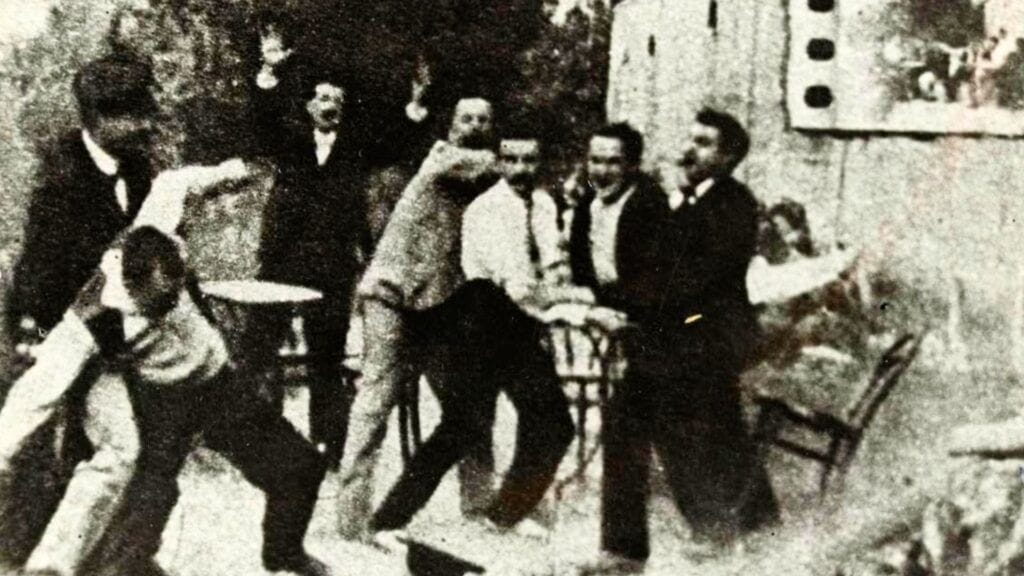
One of the first chapters bears the name Fructuós Gelabert. Raised in Sants, he built his own camera and in 1897 filmed Riña en un café, regarded by the Filmoteca de Catalunya as the first narrative film made in Spain. The scene was filmed in a courtyard between Vapor Vell and the now-disappeared Casino de Sants.
Gelabert also turned everyday neighbourhood life into cinematic material, filming workers leaving work and scenes around the parish of Sants. In 1914, he promoted Boreal Films in the area of what is now Plaça de Sants. The project encountered financial difficulties, but those studios ultimately became linked to Studio Films, one of the most important companies in Barcelona silent cinema.
It was Studio Films precisely that brought prominence to Lola París, one of the first great stars of Catalan silent cinema. Between 1914 and 1930, she starred in around thirty films, and her figure achieved a popularity unusual for an actress in those early years of the seventh art. The studios in Plaça de Sants operated until 1924.
Montjuïc subsequently took over the technological role. The former Chemistry Pavilion of the 1929 International Exposition became the Orphea studios, one of the major centres of Spanish sound cinema during the 1930s. Sound stages, sets and technical equipment meant that for a period Barcelona could compete directly with Madrid as a production centre. The story ended abruptly on 28 April 1962, when a fire destroyed the facilities.
Cinema also entered homes from Poble-sec. In 1931, the Nicolau family began producing the Cine Nic at number 175 Nou de la Rambla, a small projector inspired by the magic lantern that made it possible to reproduce cartoons using illustrated strips. The invention was hugely widespread and turned a neighbourhood address into a small factory of domestic dreams.
The district's relationship with the screen did not end with the closure of the old studios. On Rambla de Badal, Grangel Studio has taken part in designing characters for films such as Corpse Bride, Madagascar, Kung Fu Panda, The Prince of Egypt and Guillermo del Toro's Pinocchio, which won the Oscar for Best Animated Feature in 2023. From a studio in Sants, they have worked on productions associated with names such as Tim Burton, Steven Spielberg and Guillermo del Toro.
More community-based forms of that tradition also survive. The former Liceu, Montjuïc, Florida, Cine Nuevo and Gayarre cinemas shaped the district's social life for decades, while initiatives such as the Sants Fantastic and Horror Film Marathon and the screenings at Cotxeres-Casinet now maintain that relationship between screen and neighbourhood. Even EMAV, dedicated to training new generations of audiovisual professionals, is based in La Bordeta.
Sants-Montjuïc never literally became a Mediterranean Hollywood, but for several decades it had many of its ingredients: studios, producers, actors, technology and an audience willing to fill cinemas. More than a century after that filming beside Vapor Vell, the district retains something of that status as a cinematic laboratory, although much of its former sound-stage infrastructure now survives only in photographs, restored films and neighbourhood memory.