
News
Barcelona plans its largest park in La Sagrera: 36 hectares, twice the size of the Ciutadella
Barcelona has many challenges. Tourism, access to housing and increasing leisure areas. So much so that its mayor, Jaume Collboni, is certain that, in the urban transformation of La Sagrera presented at the end of this February, he is going to create the city's largest park.
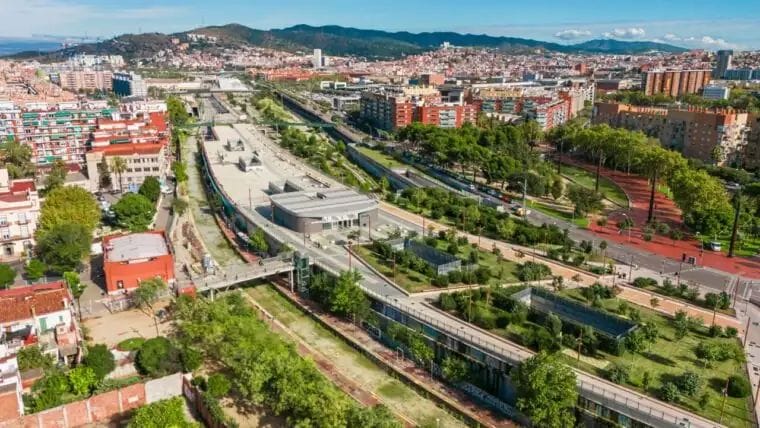
This new, large and prominent space, which will make the city even more of a benchmark for quality, sustainability and green spaces in which to walk or rest, will have 36 hectares and 4 linear kilometres and, yes, according to Colloboni, it will be the largest in the city, «twice the size of Ciutadella Park», he said at its presentation.
As well as structuring the new neighbourhood, it will form part of a continuous green corridor between the Ciutadella, the coast and the Besòs. According to the City Council, this large green area will have various spaces, some already existing, such as Torre del Fang and the gardens around Sant Andreu Comtal station. It will be completed by Sant Martí Park, the park around the station, the one above the station and the one in the Renfe Tallers area.
With public participation
During his term, Collboni has set himself the goal that citizens should have much to say in building the city. There will therefore be a participatory process with local residents, which will begin during autumn 2026, in order to define the park's characteristics.
Work on Barcelona's largest park will be carried out from 2028, with the aim that, when the station works are finished, the park can open with its trees established.
Photo by barcelona.cat
Sagrera: ring road and Sant Martí Park
A redevelopment based on the future Sagrera station
Although under construction, citizens and visitors are eagerly awaiting the completion of the new Sagrera station. It will connect the city with many others and will be a central mobility hub.
The Sagrera project encompasses a large part of the future station project. In general, the City Council stresses that it will drive a new metropolitan centre in relation to the Besòs axis and complete a model of dual polarity, alongside a renewed Sants station. «From now until 2031, Barcelona City Council will invest up to 260 million euros to bring to the city what has been an open wound in recent decades».
An important objective is therefore to overcome the physical barrier that the railway tracks have represented for decades. This will make it possible to improve the connection between the neighbourhoods in the districts of Sant Andreu and Sant Martí, which lie on either side of Sagrera.
The City Council has also announced the reinforcement of several axes: Espronceda and Bac de Roda-Felip II, and the connection of others: Garcilaso with Pont del Treball Digne, Pare Manyanet and Rambla de Prim.
Urban continuity will be important because the aim is to join Sagrera, Sant Andreu, Clot, Sant Martí and Verneda. All this thanks to the great new largest park in Barcelona, more services and facilities, and housing.
In addition, this is with an eye on the aforementioned future Sagrera station. Thus, the city will have two central and important railway stations and Barcelona will grow: Sagrera station on the one hand, and the refurbished Sants station. For the City Council, this is expected to improve the public transport network by adding new lines and stops: three metro lines, L4, L9 and L10, and three commuter rail lines, R1, R2 and R11.
Photo by barcelona.cat
Entrance to the new Sagrera station
Updated: 5 March 2026, 21:24
The urban development project around the future La Sagrera station is one of Barcelona's most ambitious transformations in decades. Beyond the 36-hectare park, the construction of more than 11,000 homes for around 25,000 new residents is planned, almost half with officially protected status, along with public facilities, offices and commercial areas that could create more than 10,000 jobs in the area. The future station will become an intermodal transport hub, integrating metro, commuter rail and high-speed lines, improving the connection between the districts of Sant Andreu and Sant Martí. In addition, the design of the park will be defined in part by the public participation planned for autumn 2026.