
News
Beyond the Pradera: the San Isidro 2026 that blends tradition, design and neighbourhoods
Between botijos turned into design, historic posters, automaton theatre, traditional Madrid settings and new sounds from Madrid, San Isidro 2026 reveals a less clichéd side of Madrid's biggest festival.
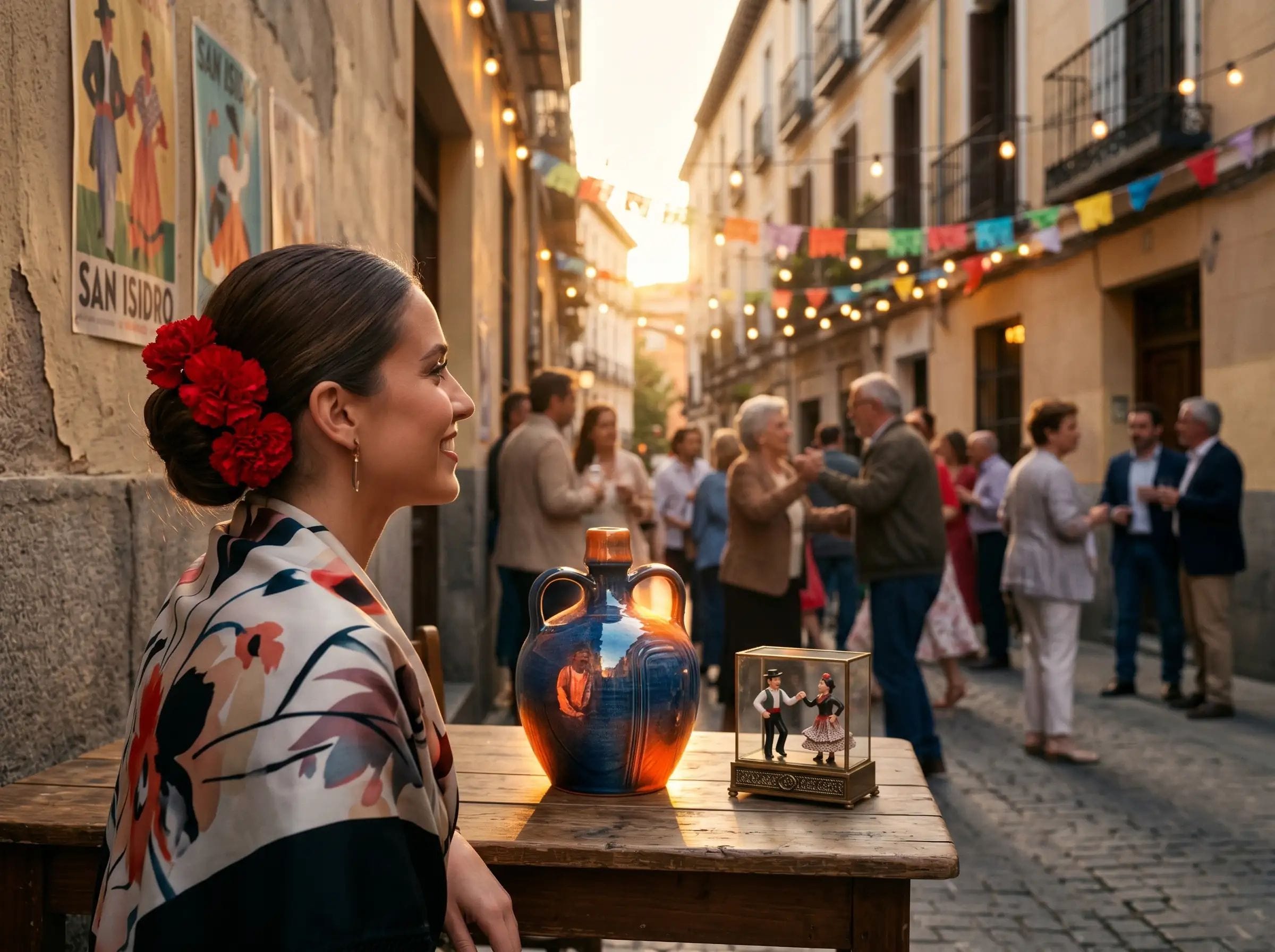
San Isidro 2026: the less obvious side of the festival Madrid is rediscovering
Talking about San Isidro usually means talking about the Pradera, rosquillas, chotis, carnations and open-air dances. But in 2026 Madrid’s biggest festival also shows another side: more visual, more rooted in heritage and more contemporary. The official programme runs from 7 to 17 May and spreads activities across venues such as Plaza Mayor, Las Vistillas, Matadero Madrid, the Pradera de San Isidro and the Museo de San Isidro.
The most interesting part is not only in the concerts or on the main stages. It lies in how the city is reinterpreting its own symbols. San Isidro no longer works solely as a traditional Madrid postcard. This year it also appears as a laboratory of popular memory, design, craftsmanship, mechanical theatre, neighbourhood markets and new music scenes.
One of the best examples is El botijo revisitado, the exhibition on view at the Central de Diseño de Matadero Madrid from 8 to 17 May. The exhibition takes a domestic, traditional Madrid object associated with water and everyday life and reinterprets it through the eyes of ceramicists linked to the municipal ceramics schools. It is a simple, highly visual way of understanding where the festival is heading: it does not erase tradition; it looks at it again.
The Teatro de Autómatas, scheduled at Matadero Madrid from 14 to 17 May, also stands out. It is a fairground booth with mechanical figures and scenes of everyday life, a piece somewhere between popular theatre, artisanal engineering and urban memory. In a festival so closely tied to tradition, recovering this kind of heritage helps tell a less obvious and much richer story of San Isidro.
Another clue lies in the exhibition Carteles de San Isidro. La imagen de las fiestas, at the Museo de San Isidro. Los Orígenes de Madrid, from 14 May to 20 September. The proposal lets visitors trace the visual evolution of the festival and observe how Madrid has represented itself each May. It is a very different reading of San Isidro: not through the open-air dance, but through imagery, graphic design and collective memory.
The festival also moves through the neighbourhoods. In addition to the major stages, the official programme includes traditional Madrid activities, workshops, family proposals, displays, concerts and gatherings spread across different spaces in the city. That expansion means San Isidro is not experienced only as a mass gathering in the Pradera, but as a more distributed, more urban celebration closer to everyday life in Madrid.
Musically, 2026 also plays with that blend. The programme combines open-air dances, traditional Madrid stages, family proposals and large-format concerts with new Madrid scenes. At Las Vistillas, for example, there is the Nuevo Madriz block, a clear sign that the festival does not want to remain enclosed within an old image of traditional Madrid culture.
That is why perhaps the real novelty of San Isidro 2026 is not one specific activity but an idea: Madrid is treating its tradition as something alive. A botijo can be design. A mechanical booth can be heritage. A festival poster can tell decades of urban identity. And an open-air dance can coexist with new music without ceasing to be traditional Madrid culture.
For anyone wishing to go beyond the basic guide, this is the most appealing part of San Isidro 2026: the festival not only preserves customs, it also edits them anew. And there a less clichéd, more curious version of Madrid emerges, probably one that is truer to the city today.